
The men’s tournament had a title sponsor from Day One. The women’s version played 12 editions over 21 years before a brand said yes. The gap between those two facts is the story of regional women’s football in numbers.
Global Game | June 2026
The Number That Starts Everything
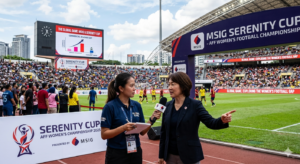
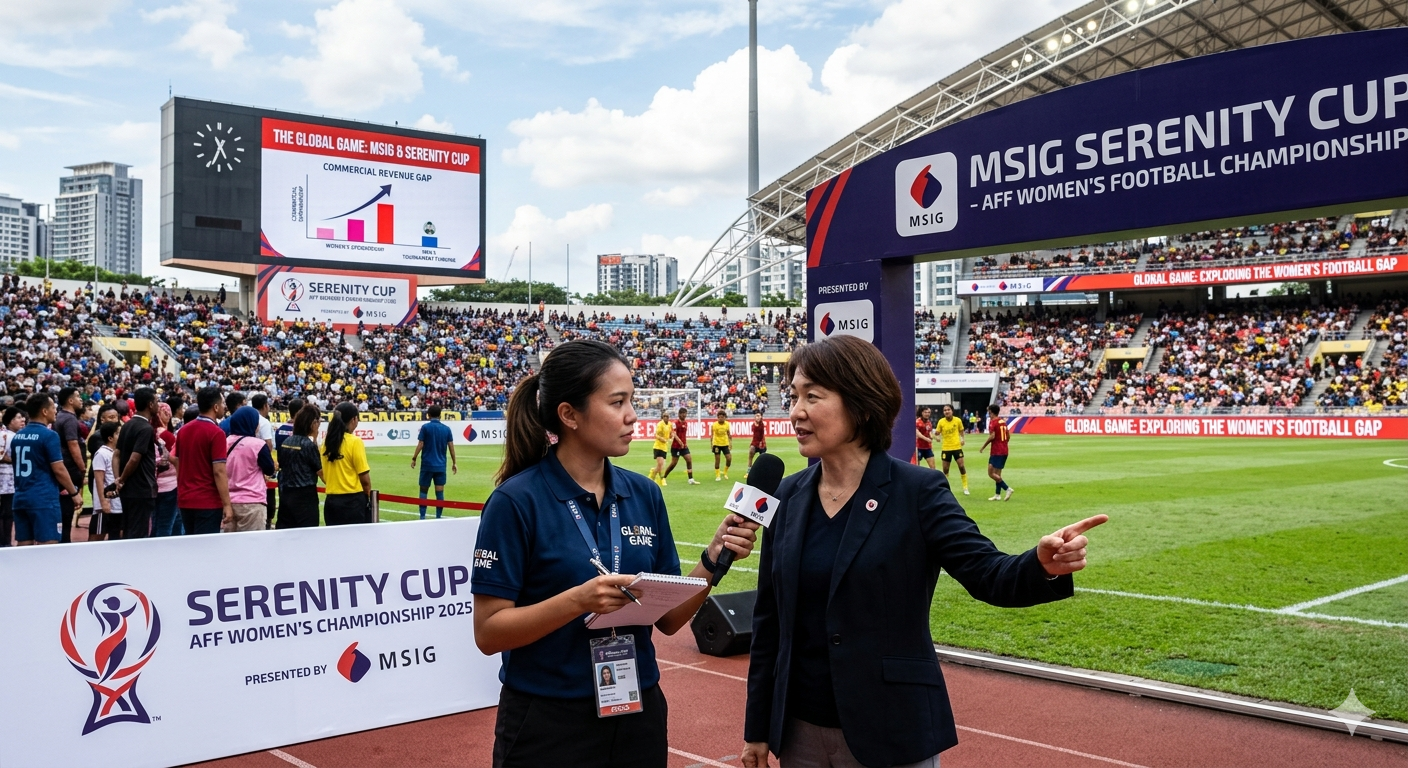
When the 2025 ASEAN Women’s MSIG Serenity Cup kicked off in Vietnam in August, it carried a title sponsor for the first time in its twenty-one-year history. MSIG, the leading general insurer in ASEAN by gross written premiums, became the first brand to put its name on Southeast Asia’s premier women’s football tournament.
Thirteen editions. Twenty-one years. One hundred and twelve matches of international women’s football, including three nations that went on to qualify for FIFA Women’s World Cups.
Not a single title sponsor until now.
The men’s equivalent tournament — the ASEAN Championship — was called the Tiger Cup from the day it was born in 1996. A beer company, Asia Pacific Breweries, had its name on the trophy before the first ball was kicked. The men’s tournament has not played a single edition without a title sponsor in its entire thirty-year history.
That gap — zero editions versus thirteen editions — is not just a marketing statistic. It is a precise measurement of how long the commercial world decided women’s football in Southeast Asia wasn’t worth paying for. And understanding how that gap formed, and why it is now finally beginning to close, requires going further than the press release that announced the MSIG deal.
Part One: How the Men’s Tournament Was Born Sponsored
The ASEAN Championship for men — known across most of its life as the AFF Cup — launched in Singapore in September 1996 with ten nations, twenty-four matches, and a beer company’s name above the door.
Tiger Beer’s parent company, Asia Pacific Breweries, was the inaugural title sponsor. The logic was straightforward: football in Southeast Asia was already a mass-market product, the AFF’s ten member nations represented a population of several hundred million, and beer advertising and football sponsorship had a long-established commercial relationship globally. The Tiger Cup was a natural fit. The brand stayed through nine editions and nine years, until Asia Pacific Breweries withdrew in 2007.
Even then, the tournament went without a title sponsor for only one cycle — the 2007 AFF Cup played without naming rights — before Suzuki, the Japanese automotive company, stepped in for 2008. The AFF Suzuki Cup became one of the most recognisable sporting brands in Southeast Asia, running from 2008 through 2020 across seven consecutive editions. When Suzuki eventually stepped back, Mitsubishi Electric took over in 2022. And when Mitsubishi Electric concluded its tenure after the record-breaking 2024 edition, Hyundai Motor stepped in for 2026.
The sponsorship succession reads like a relay race. Tiger Beer hands to a gap of one edition, which hands to Suzuki, which hands to Mitsubishi Electric, which hands to Hyundai. Thirty years of continuous commercial backing, with only a single edition between 2004 and 2007 played without naming rights.
The women’s tournament, which started in 2004, played twelve consecutive editions without finding the equivalent of that first baton pass.
Part Two: What Twelve Editions Without a Sponsor Actually Means
The ASEAN Women’s Championship launched in 2004 — the same year, not coincidentally, that Tiger Beer left the men’s tournament and left it briefly without a sponsor. From the beginning, the women’s competition was operating in a different commercial universe.
The tournament ran biennially when it could. Editions were held in 2004, 2006, 2007, 2010, 2011, 2012, 2014, 2015, 2016, 2018, 2019, and 2022. Twelve editions across eighteen years, featuring some genuinely significant football: Thailand won four times and became a regional powerhouse. Vietnam won three times and eventually reached the 2023 FIFA Women’s World Cup. The Philippines, who had barely registered on the regional football map, won in 2022 and qualified for the same 2023 World Cup. Myanmar produced players who would go on to play in Australia and Europe.
None of that generated a naming rights sponsor. The tournament existed, it grew, it produced results that mattered — and the commercial world did not follow.
The reasons are not mysterious. They are structural, regional, and in some ways self-fulfilling. Without broadcast deals at scale, sponsors cannot quantify their audience. Without sponsors, broadcast deals are harder to negotiate. Without both, the marketing around the tournament is limited, which means the audience doesn’t grow, which means the sponsors don’t come. The men’s tournament broke that cycle on day one because men’s football in Southeast Asia already had the audience. The women’s tournament had to build the audience first, without the marketing budget to do it.
That loop — no sponsor means no broadcast means no audience means no sponsor — is the structural trap that every emerging women’s sports competition faces. It is the same trap the WNFC’s Odessa Jenkins describes when she talks about women’s football in America. The geography is different. The mechanics are identical.
Part Three: The Numbers That Finally Broke the Cycle
The MSIG deal did not arrive because the AFF got lucky or finally found the right pitch. It arrived because three specific things happened that made the commercial case impossible to ignore.
The first was the 2023 FIFA Women’s World Cup. Three AFF member associations — Vietnam, the Philippines, and Australia — qualified for the same Women’s World Cup. For a regional federation that had spent years arguing that women’s football in Southeast Asia was commercially viable, three nations at a single World Cup was the proof of concept that no amount of internal advocacy could manufacture. Brands that had been circling the conversation suddenly had a concrete performance benchmark to point to.
The second was the MSIG deal’s own regional logic. MSIG is not a global conglomerate making a statement about women’s football worldwide. It is ASEAN’s leading general insurer, headquartered in Kuala Lumpur, selling insurance products across the precise nations that the Women’s Championship represents. The tournament’s footprint maps almost exactly onto MSIG’s commercial territory. The sponsorship is targeted, not aspirational — and that targeting is what made it commercially rational rather than philanthropic.
The third was the qualification round introduced for the first time at the 2025 edition. The AFF created a separate qualifying tournament — the 2024 AFF Women’s Cup — to determine which nations earned spots in the main championship. That structural change did two things simultaneously: it created more competitive matches across more nations throughout the calendar year, which generates more content and more broadcast hours, and it signalled institutional seriousness about the competition’s integrity. Earned qualification is a sponsor-friendly story. It means the teams in your tournament deserve to be there.
Together, those three developments created enough commercial justification for MSIG’s CEO to stand up and say: “Our goal through this partnership is clear — elevate women’s football in this region.”
Part Four: The Viewership Gap in Hard Numbers
Here is where the gap between the men’s and women’s tournaments becomes most quantifiable — and most uncomfortable.
The 2024 ASEAN Championship for men, played across December 2024 and January 2025, generated 541.5 million cumulative broadcast viewers and 12.7 billion social media video views. The final between Vietnam and Thailand drew a peak of 19.6 million concurrent viewers on YouTube Live — setting a new all-time record for the platform, surpassing every football match, boxing event, and streaming moment in the platform’s history. Vietnam’s FPT channel alone peaked at 4.9 million concurrent viewers. Thailand’s BG Sports channel peaked at over 2 million. The match was, simply, the most-watched live event in the history of YouTube.
The 2025 Women’s Championship viewership figures have not been disclosed publicly in comparable terms. The AFF and MSIG have published broadly positive language about the tournament’s reach, but no equivalent headline number has been released. That absence is itself a data point — tournament organisations that generate 541 million viewers publish that figure prominently. The equivalent figure for the women’s tournament, if it existed at scale, would have been in every press release.
Based on available information, the women’s tournament draws crowds of between 5,000 and 10,000 per edition on average, with peaks of around 8,000 at the 2022 final in the Philippines. The men’s tournament consistently draws tens of thousands per match and generates national television primetime coverage across all ten participating nations simultaneously.
The broadcast infrastructure gap is similarly stark. The 2024 men’s championship had named broadcast partners in every participating nation: Bayon TV in Cambodia, MNC in Indonesia, Astro in Malaysia, Skynet in Myanmar, Matchday Media in the Philippines, Mediacorp in Singapore, AIS Play and TrueSport in Thailand, VTV and FPT in Vietnam. Every country. Multiple partners in some. The women’s championship is broadcast, but the multi-nation, multi-platform infrastructure that generates half a billion cumulative viewers does not yet exist around the women’s competition.
That broadcasting gap directly constrains the sponsorship gap. Mitsubishi Electric’s investment in the men’s tournament was justified by 305 million viewers in 2022 and 541 million in 2024. MSIG’s investment in the women’s tournament is a bet on where those numbers are going, not where they currently are. That is a meaningful distinction — it means MSIG is taking a position, not following established evidence. That takes a specific kind of commercial courage, and it deserves to be named as such.
Part Five: The Global Pattern — This Is Not Just a Southeast Asian Story
The gap between men’s and women’s tournament sponsorship timelines in Southeast Asia follows a pattern visible across every region of the world where second and third-tier international competitions exist.
The UEFA Nations League, launched in 2018, had a naming rights sponsor — Endesa — before its inaugural edition. The UEFA Women’s Nations League, launched in 2023, is still without a title naming rights sponsor five years into its existence. The CAF Africa Cup of Nations for men has had consistent title sponsorship since the early 2000s. The Women’s AFCON played its 2024 edition — the thirteenth in its history — without a naming rights title sponsor, echoing the ASEAN women’s situation almost exactly.
The CONCACAF Gold Cup for men has been sponsored since the mid-2000s. The W Gold Cup, launched in 2024, completed its inaugural edition without a title naming rights partner.
The pattern is consistent enough to be a rule rather than an exception: men’s regional international competitions attract title sponsors at or near launch. Women’s equivalents play between ten and twenty editions before commercial backing arrives at the same level — if it arrives at all.
The mechanism is always the same. Sponsors follow proven audiences. Proven audiences require broadcast infrastructure. Broadcast infrastructure requires investment. Investment requires commercial justification. Commercial justification requires proven audiences. The loop only breaks when someone — a federation, a brand, a broadcaster — decides to invest ahead of the evidence rather than behind it.
In Southeast Asia, MSIG broke that loop in 2025 for the women’s game. In the UK, the Women’s Super League reached its own equivalent moment when Barclays signed a title partnership in 2021, more than a decade into the league’s existence. In the United States, the NWSL played twelve seasons before landing its first major jersey sponsorship infrastructure. In every case, the investment preceded scale. The scale followed the investment.
The question the MSIG deal raises for Southeast Asia is whether it represents a genuine inflection point — the moment the commercial loop breaks permanently — or a single sponsorship that doesn’t generate successors. The men’s tournament had Tiger Beer for nine years, then a gap, then Suzuki for twelve years, then Mitsubishi Electric, then Hyundai. The continuity of that succession is what built the commercial infrastructure. The women’s tournament needs its own succession story. MSIG is, potentially, the Tiger Beer moment. Whether it becomes the Tiger Beer moment depends on what the numbers from the 2025 tournament look like when the AFF next goes to market.
Part Six: What the Numbers Don’t Show
There is one thing the viewership comparison between the men’s and women’s tournaments consistently obscures: the direction of travel.
The men’s tournament drew 10,229 fans per match at its inaugural edition in 1996. It took more than a decade of consistent sponsorship, broadcast investment, and competitive development before it became the half-billion-viewer property it is today. The comparison between 541 million men’s viewers in 2024 and unmeasured women’s viewers in 2025 is not a comparison between equivalent stages of development. It is a comparison between a thirty-year-old commercial product and a twenty-one-year-old one that just found its first sponsor.
The relevant comparison is between where the men’s tournament was after its first title sponsor — sometime around 1998 or 2000, when the Tiger Cup was four years old and growing but not yet a regional institution — and where the women’s tournament is in 2026, with MSIG in place, qualification rounds established, and three nations fresh from World Cup appearances.
On that basis, the gap is not as large as the headline numbers suggest. It is, in fact, smaller than it has been at any comparable stage of the men’s tournament’s development — because the women’s game in Southeast Asia is growing into a global context where women’s football has already proven its commercial value at scale in Europe and North America, generating billions of dollars in broadcasting rights, sponsorships, and franchise valuations that simply did not exist as reference points when the men’s tournament was finding its feet in the late 1990s.
The global proof of concept exists now. Southeast Asian women’s football doesn’t have to convince brands that women’s sports can be commercially viable. It only has to demonstrate that this specific tournament, in this specific region, represents the right vehicle for that investment.
MSIG decided, in 2025, that it does. Whether they are right will be answered by the viewership numbers the 2025 tournament eventually publishes — and by whether a second brand signs up for the next edition.
The Bottom Line
The ASEAN Women’s Championship took thirteen editions and twenty-one years to land a title sponsor that the men’s equivalent had from day one. That gap is real, documented, and represents two decades of commercial undervaluation that cannot be explained by quality alone — three of the tournament’s nations reached the same Women’s World Cup in 2023.
The men’s tournament is now the most-watched live event in YouTube history. The women’s tournament does not yet publish equivalent viewership data. That gap in transparency is itself telling — the numbers that exist are not yet the numbers you lead with.
What is also true is that MSIG’s arrival changes the structural equation for the first time. The loop — no sponsor, no broadcast scale, no audience growth, no sponsor — has been interrupted. The question is whether it stays interrupted.
The men’s tournament had Tiger Beer for nine years. If MSIG stays for five, and is followed by something bigger, the ASEAN Women’s Championship will have its own succession story. And the 21-year gap between the two tournaments’ first title sponsors will begin to look less like permanent structural inequality and more like the specific, time-bounded lag that has characterised the commercial development of women’s sports everywhere the investment has eventually arrived.
That is not optimism. It is pattern recognition. The pattern says investment precedes scale. MSIG just invested.
Now the scale has to follow.