

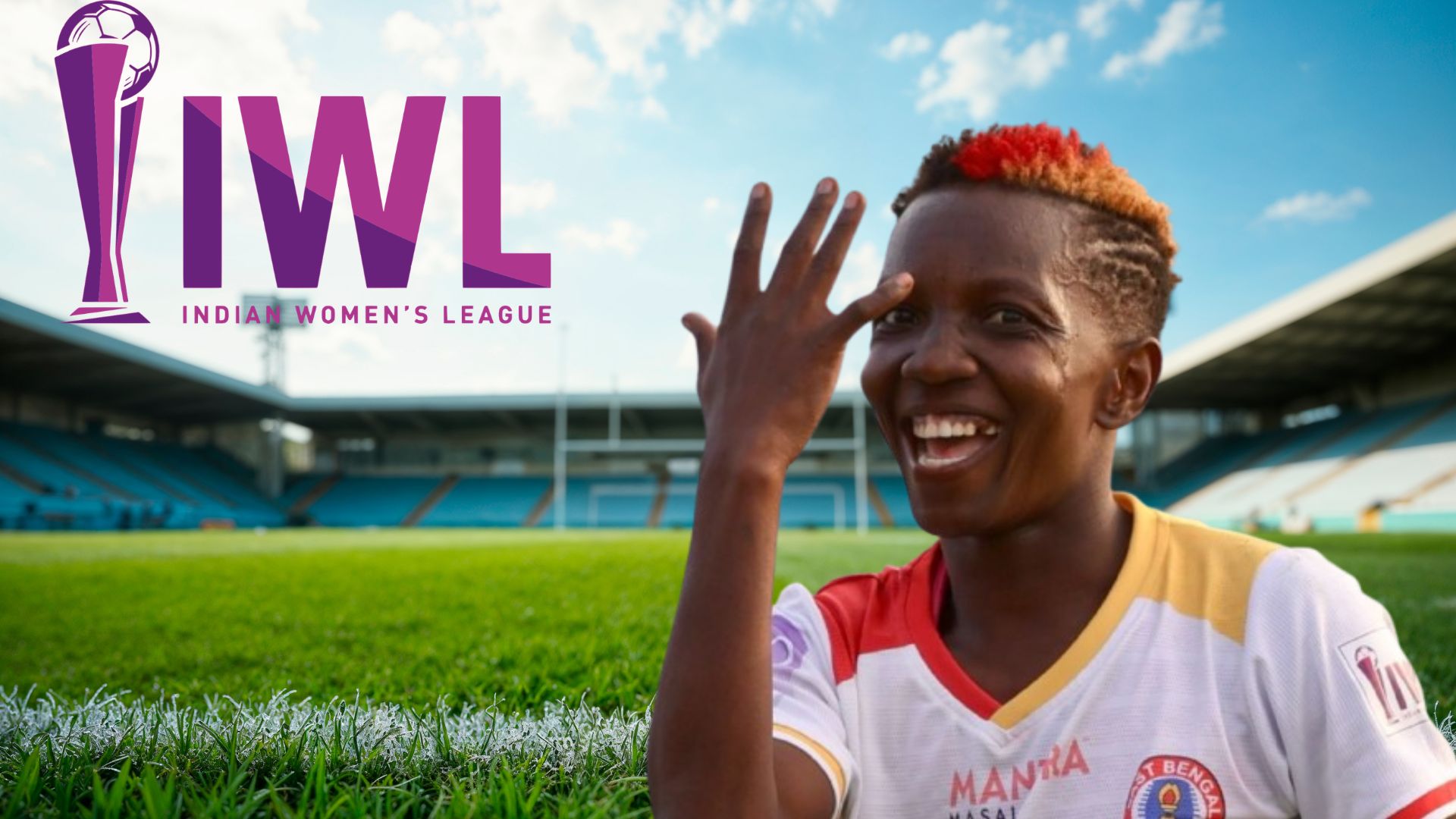
Five countries. Three continents. One Golden Boot, twice over. Fazila Ikwaput’s path to becoming the Indian Women’s League’s second-highest scorer of all time didn’t run through India at all — until it did, and then it never really left.
Global Game | June 2026
The Number
Fifty-four.
That’s where Fazila Ikwaput’s IWL goal tally sat after her hat-trick against Sribhumi FC in April 2026 — a result that pushed East Bengal’s lead at the top of the table to 21 points from seven matches, and quietly moved Ikwaput into second place on the all-time IWL scoring list. Only Nepal’s Sabitra Bhandari, one of South Asian football’s genuine legends, sits above her.
Fifty-four goals. Four seasons in Indian football. A Ugandan forward, twenty-five years old, now sitting in the record books of a country she didn’t grow up in, playing a league she didn’t grow up watching, for a club that didn’t exist in her career plans until eighteen months ago.
This is the story of how she got there — and the question every IWL follower is now quietly asking: how much longer does India get to keep her?
Five Countries Before Twenty-Five
Most footballers’ early careers follow a recognisable shape — academy, first team, maybe a loan, maybe a transfer to a bigger club in the same country or region. Ikwaput’s early career looks more like a map of football’s outer frontiers.
She started at Olila High School Ladies in Uganda, the kind of grassroots foundation that produces most African talent. By 2018, still a teenager, she had already made her first move abroad — to Gokulam Kerala in India, for what would turn out to be a brief first stint. The same year, she moved again, this time to BIIK-Kazygurt in Kazakhstan.
That Kazakhstan move produced the first genuinely historic moment of her career. Playing for BIIK-Shymkent in the 2018-19 UEFA Women’s Champions League, Ikwaput became the first Ugandan woman ever to appear in the competition. Not the first Ugandan to play in Europe — the first to play in the continent’s premier club competition, full stop. At eighteen years old, in a country most football fans couldn’t place on a map, she had already done something no Ugandan footballer, male or female, had done before her.
From there, the journey continued. Lady Doves FC from 2019 to 2022 — three years, presumably back closer to home, building toward her senior international career with Uganda. Then Omonia Women FC in Cyprus from 2022 to 2023, another European stop, another league, another adjustment.
And then, in January 2024, she went back to where it had all started in India: Gokulam Kerala.
This time, it stuck.
The Gokulam Explosion
Ikwaput’s return to Gokulam Kerala for the 2023-24 IWL season produced an immediate, emphatic statement. She finished the season as the league’s top scorer with 13 goals in nine matches — a goals-per-game ratio that would be remarkable in any league, let alone one she was rejoining after a five-year absence. Her debut for the club in that spell came with two goals in an 8-0 win over Sports Odisha. Later in the same campaign, she scored a hat-trick against East Bengal in a 4-0 win — the club that would, within two years, become her own.
She wasn’t finished. Across her two seasons at Gokulam Kerala — 2023-24 and 2024-25 — Ikwaput scored 42 goals total and won the IWL Golden Boot in both campaigns. Back-to-back top scorer titles in Indian women’s football’s top division. By the time her second Golden Boot season ended, she was, by any reasonable measure, the most dominant individual attacking presence the IWL had seen in years.
That kind of form does not go unnoticed. And in the summer of 2025, the biggest club in the league’s recent history came calling.
East Bengal’s Statement Signing
When East Bengal FC Women announced their squad for the 2025-26 season, the headline wasn’t just Ikwaput. It was Ikwaput, plus Shilky Devi — a regular starter for India’s senior national team and the IWL’s reigning Best Midfielder — plus Payal Basude, a goalkeeper who had already won the IWL and the Senior Women’s National Football Championship at just nineteen. All three arrived from the same club: Gokulam Kerala.
And alongside the players came the coach. Anthony Andrews, who had managed all three at Gokulam, moved to East Bengal in the same transfer window. His comment on reuniting with Ikwaput was simple and telling: “It’s a great feeling to reunite with these players. Fazila is a natural leader on the pitch.”
This was not an incremental signing. This was East Bengal — one of the two great institutions of Kolkata football, with over a century of history on the men’s side and a women’s team only four seasons into the IWL — assembling a coach-and-core-players package wholesale from the club that had dominated the league for years before them. The stated ambition, in East Bengal’s own announcement, was explicit: defend the domestic double of the IWL and the Calcutta Women’s Football League, and “compete at the highest level in Asia” in the AFC Women’s Champions League.
Gokulam Kerala lost their best striker, their best midfielder, their best young goalkeeper, and the coach who had built a title-winning identity around all three. East Bengal gained all of it at once. In a league with no transfer fee disclosure and no real free agency framework to speak of, this is about as close to a coordinated takeover of a winning formula as Indian women’s football has seen.
The early results justified the ambition. East Bengal won the IWL title in Ikwaput’s first season at the club — back-to-back titles for East Bengal overall, and Ikwaput’s third individual Golden Boot in a row when her 2025-26 numbers are counted alongside her Gokulam tallies.
Vice-Captain of Uganda — and Still Climbing
While Ikwaput’s club career has been built almost entirely outside Uganda, her international career has grown alongside it. She has represented Uganda’s senior women’s national team since 2016 — meaning she was already a senior international before most of her European and Asian club moves had even happened. By 2025, she had become the team’s vice-captain.
That role matters in the context of her IWL story. Ikwaput is not a player using Indian football as a retirement tour or a pay-the-bills stopover between bigger opportunities. She is, simultaneously, one of the senior leadership figures in her national team’s setup — meaning her form in the IWL feeds directly into Uganda’s competitiveness in CAF Olympic qualifying, the Africa Cup of Nations, and wherever else the Crested Cranes compete. Her career is operating on two tracks at once: club dominance in India, and continued senior responsibility for her country.
For a twenty-five-year-old, carrying both of those simultaneously — while also being the IWL’s most feared attacker — is a significant load. That she’s carrying it while also putting up career-best numbers suggests either remarkable durability or a level of talent that simply hasn’t found its ceiling yet. Possibly both.
The Continental Reality Check
East Bengal’s AFC Women’s Champions League campaign — the explicit reason the club assembled its 2025-26 squad the way it did — provided the first genuine test of whether Ikwaput’s IWL dominance translates upward.
The preliminary stage went well: East Bengal topped their group. The group stage in China was a different proposition entirely. Against Uzbekistan’s PFC Nasaf, East Bengal lost. The gap between IWL-level competition and continental Asian competition was, in that result, laid bare.
This is not a knock on Ikwaput specifically — it’s a structural reality about the level the IWL currently operates at versus the level of clubs that have been fully professional, continentally experienced operations for years. But it does raise the question that follows any dominant player in a developing league: is this the level she should be playing at, or is this the level she’s outgrown?
Her career to this point suggests she has never stayed anywhere very long once she’s extracted what she can from it. Uganda to India to Kazakhstan to Uganda’s domestic football to Cyprus to India again. Four seasons in the IWL is already the longest sustained stretch of her career in one football ecosystem. The question of where she goes next — and when — is not hypothetical. It’s a pattern.
The Fan Conversation Happening Underneath the Goals
There’s a tension running through how Indian football fans talk about Ikwaput, and it’s worth naming directly because it’s not going away.
The appreciation is genuine and widespread. Fans describe her as “unstoppable,” praise her movement off the ball as “world-class,” and openly hope more people start watching IWL matches because of players like her. That’s not faint praise — that’s a fanbase recognising they’re watching something special.
But there’s an undercurrent too. One fan comment captured it precisely: “Great to see Ugandan players like Fazila making a mark in Indian football. But we need to develop our own local strikers too — Bala Devi and Sabitra are legends, but the gap after them is concerning.”
That’s not a criticism of Ikwaput. It’s a structural worry about what it means for Indian football’s development pipeline when the league’s most dominant attacking player, for four consecutive seasons, has been a foreign import. Bala Devi and Sabitra Bhandari — the South Asian legends being referenced — represent a generation. The fan’s question is whether Indian football is producing the next one, or whether the IWL’s rising quality is being driven primarily by recruitment rather than development.
It’s the exact same tension we identified in the broader IWL landscape: foreign signings raising the league’s ceiling while the pathway for domestic talent to reach that same ceiling remains underbuilt. Ikwaput, through no fault of her own, has become the most visible face of that tension simply by being too good for four straight seasons.
What Happens Next
Here’s the honest assessment of where this story sits in June 2026.
Ikwaput is twenty-five — entering what should be the peak years of her career. She has just helped East Bengal to back-to-back IWL titles, sits second on the all-time IWL scoring chart with a tally that’s still climbing, and has continental experience in both Europe and Asia. She is the vice-captain of her national team. By every measure, she is performing at a level that exceeds what the IWL, as a league, can currently offer in terms of pay, continental competitiveness, and broadcast visibility.
The IWL’s structural gaps — the pay ceiling that sits well below ₹1 lakh for most players, the limited continental success against fully professional Asian opposition, the modest crowds — are gaps that affect every player in the league. For most IWL players, those gaps are simply the conditions of their career. For Ikwaput, with her track record of moving on once a league has given her what it can, those same gaps look more like a countdown.
Her contract situation beyond the current season hasn’t been publicly disclosed. Her history suggests she doesn’t stay anywhere indefinitely once she’s proven what she can do. Four seasons in the IWL — across two clubs, two Golden Boots, and now a second-place finish on the all-time scoring chart — is already a longer stay than most stops on her career map.
If she leaves, East Bengal loses the player who was the centrepiece of their entire 2025-26 recruitment strategy, and the IWL loses its most prolific active scorer. If she stays, it will say something meaningful about what the league is becoming — that a player of her calibre, with options elsewhere, chooses to keep building her legacy in India rather than moving on as she always has before.
Either way, the next chapter of Fazila Ikwaput’s story will tell us something important about where Indian women’s football actually stands. Not in terms of structure or policy — but in terms of whether its best player wants to be there.