


Two players. Two continents. One country in between that almost nobody associates with women’s football. The route from West Africa to Asia’s emerging leagues runs through a place you wouldn’t expect — and the players taking it are breaking scoring records everywhere they land.
Global Game | June 2026
Two Players, One Pattern
Start with two numbers.
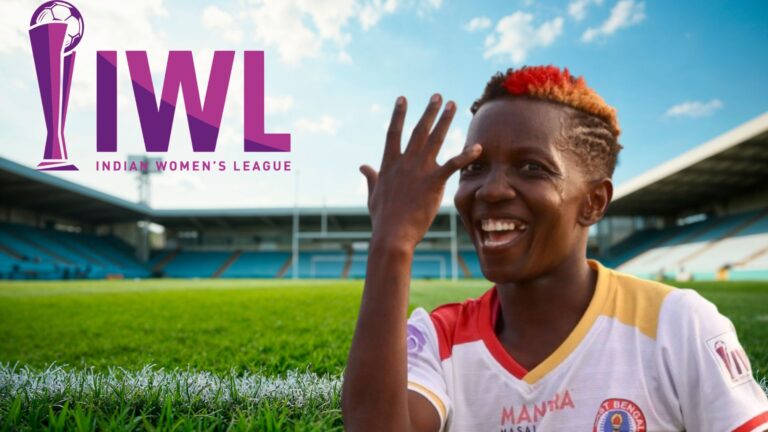
Forty-two. That’s how many goals Fazila Ikwaput scored across two seasons at Gokulam Kerala in the Indian Women’s League, winning back-to-back Golden Boots before moving to East Bengal and becoming the IWL’s second-highest all-time scorer.
Forty-two. That’s also how many goals Marie Ngah scored in a single season for FC Okzhetpes in the Kazakhstan Premier League — enough to make her the league’s Top Goalscorer in 2021-22.
Same number. Different continents. Different leagues. Different sports federations entirely. And yet the shape of these two careers is close enough to look like a blueprint — because, increasingly, it is one.
Ikwaput is Ugandan. Ngah is Cameroonian. Both are West and Central African forwards who left home as teenagers, both passed through Kazakhstan’s domestic football pyramid on their way to becoming record-breaking imports somewhere else, and both are now established figures in leagues — the IWL in India, the Turkish Süper Lig for Ngah — that didn’t exist as serious destinations for African players a decade ago.
This is not a coincidence. It’s a pipeline. And almost nobody is covering it as one.
The Kazakhstan Connection
If you wanted to design the least obvious launching pad for African forwards heading toward Asian domestic leagues, Kazakhstan might be exactly what you’d come up with.
The Kazakhstan Premier League — the country’s top women’s football division — sits in a strange geographic and football no-man’s-land. Kazakhstan competes in UEFA, not the AFC, despite being substantially in Asia geographically. Its national team plays in European World Cup qualifying groups against the likes of Belarus, Armenia, and Luxembourg. Its domestic league is obscure even by the standards of obscure leagues — yet it has, repeatedly, become the first serious professional contract for West and Central African forwards moving abroad.
Marie Ngah’s path through it is instructive. She started at Amazone FAP in Cameroon, then in 2021 — barely out of her teens — joined Okzhetpes in Kokshetau, a Kazakh city most football fans couldn’t locate on a map. One season later, she had scored 42 goals and was the league’s Top Goalscorer. She then returned to Cameroon, joined Lekié, scored 23 goals in 30 games, and was named Top Goalscorer of the Cameroonian Women’s Championship for 2022-23 — taking the experience and reputation from Kazakhstan home with her. From there, she moved to Hakkarigücü in Turkey, and now plays for Galatasaray in the Turkish Women’s Super League.
Fazila Ikwaput’s path runs almost in parallel, but with the order flipped. She started in Uganda, made an early stop at Gokulam Kerala in India in 2018, then moved to BIIK-Kazygurt in Kazakhstan the same year — where, playing for BIIK-Shymkent, she became the first Ugandan woman ever to appear in the UEFA Women’s Champions League. From Kazakhstan, she went to Lady Doves FC, then to Omonia in Cyprus, and finally back to India — first Gokulam Kerala again, then East Bengal, where she now sits as the IWL’s second all-time leading scorer.
Two players. Two Kazakh clubs — BIIK-Kazygurt and Okzhetpes. Two African Football Championship-level scoring records set in Kazakhstan within a few years of each other. Neither club, nor the Kazakhstan Premier League itself, gets discussed as a destination for African talent in any mainstream football conversation. And yet here are two players who used it as exactly that.
Why Kazakhstan specifically is hard to pin down precisely — visa pathways, agent networks, and lower-tier European football’s increasing willingness to recruit from Central Asia as a stepping stone all likely play a role. But the pattern itself is now visible across at least two separate, fully-formed careers. That’s no longer an anomaly. That’s a route.
What Happens After Kazakhstan
The more interesting part of this story isn’t the Kazakhstan stopover itself — it’s where these players go next, and what that says about which leagues are actively recruiting African goal-scoring talent right now.
For Ngah, the next stop was Turkey — a country whose women’s Super Lig has been quietly importing talent from across Africa, Eastern Europe, and South America for several years as it builds toward genuine competitiveness in UEFA Women’s Champions League qualifying. Galatasaray signing a Cameroonian forward with a Kazakhstan Premier League scoring title on her résumé is, in the context of Turkish football’s broader recruitment strategy, entirely unsurprising.
For Ikwaput, the next stop was India — a country whose football landscape looks nothing like Turkey’s, but which has developed its own version of the same recruitment logic. The IWL doesn’t have the budget or profile to compete for established European talent. What it can do is identify forwards who’ve already proven themselves prolific in lower-profile leagues — Kazakhstan, in Ikwaput’s case — and bring them in to elevate the domestic competition’s standard. Gokulam Kerala did exactly that in 2024, and the result was back-to-back Golden Boots and a move to India’s most storied football club.
Both moves worked, in the narrow sense that both players became among the most dominant attacking forces in their new leagues almost immediately. Both moves also raise the same question that’s been quietly building in IWL coverage for the past two seasons: what does it mean for a developing league’s talent pipeline when its most dominant attacking players, season after season, are imports?
The Supply Side — Why West Africa Specifically
The Ikwaput-Ngah parallel isn’t isolated. It sits on top of a much broader pattern of West and Central African scoring depth that simply hasn’t had enough domestic or continental outlets to absorb it.
Look at the 2024-25 Women’s Africa Cup of Nations scoring charts. Nigeria alone placed four players in the tournament’s top fourteen scorers — Chinwendu Ihezuo, Esther Okoronkwo, Rasheedat Ajibade, and Folashade Ijamilusi. Ghana’s Alice Kusi was also among the leaders. That’s a striking concentration of attacking talent from two countries at a single continental tournament — and AFCON itself only runs every two years, with a limited number of roster spots and an even more limited number of marquee attacking roles per nation.
For every Ihezuo or Ajibade who finds a path to Europe’s bigger leagues — and several Nigerian forwards already have — there are players just below that tier who are good enough to dominate a Kazakhstan Premier League or an Indian Women’s League, but not yet positioned for a move to England, Spain, or Germany. Those players need somewhere to go. Increasingly, “somewhere” means wherever a club with enough budget for one marquee foreign signing happens to be looking.
This is the supply side of the pipeline: West and Central African football academies and domestic leagues are producing more elite goal-scoring forwards than AFCON rosters, European top-flight clubs, and each country’s own domestic league can collectively absorb. The overflow goes somewhere. Kazakhstan, Turkey, India, and likely several other emerging leagues across Asia and Eastern Europe are increasingly where it lands.
What This Means for the Leagues on the Receiving End
For leagues like the IWL, the effect of this pipeline is genuinely double-edged, and both sides of that edge are real.
The upside is straightforward: Ikwaput’s arrival at Gokulam Kerala, and then East Bengal, didn’t just add goals to a stat sheet. It raised the competitive standard of every match she played in. Defenders across the IWL had to adjust to a different calibre of movement and finishing than most had faced before. That kind of exposure — even to a single elite opponent — has a measurable effect on a league’s overall development, the same way a single dominant overseas signing in any sport tends to lift standards across an entire competition.
The downside is the one Indian fans have already started voicing: if the league’s most dominant attacking players are consistently imports, what does that mean for the development pathway of domestic strikers? The comment that’s followed Ikwaput throughout her IWL career — “we need to develop our own local strikers too” — isn’t really about Ikwaput. It’s about whether a steady supply of West African imports becomes a substitute for domestic striker development rather than a complement to it.
There’s no clean answer here, and pretending there is would be dishonest. The Turkish Süper Lig has absorbed Marie Ngah and dozens of players like her for years without it becoming a defining controversy — partly because Turkey’s domestic talent pool is large enough and its league old enough that imports register as additions rather than as the entire conversation. The IWL, nine seasons old and still building its fundamental structures, doesn’t have that buffer yet. A single dominant import is a much bigger proportion of a smaller, younger league’s overall narrative.
The Bigger Picture — A Pipeline With No Name
What’s most striking about all of this is how completely uncovered it is as a phenomenon. Marie Ngah’s move from Cameroon to Kazakhstan to Turkey has been reported, in pieces, by club announcements and Wikipedia updates. Fazila Ikwaput’s move from Uganda to Kazakhstan to India has been reported the same way — fragments, transfer announcements, nothing connecting the dots.
Nobody has named this pathway, because until you put the two careers side by side, it doesn’t look like a pathway. It looks like two unrelated transfer stories in two leagues nobody pays much attention to.
But the pattern is real, and it’s likely bigger than just these two players. If Kazakhstan’s domestic league has functioned as an entry point for two African forwards who went on to dominate elsewhere, it’s worth asking who else has passed through it, and where they ended up. If the IWL’s recruitment of Ikwaput worked as well as it appears to have, other Indian clubs — and other South Asian leagues entirely, including Bangladesh and Nepal’s domestic competitions — may well be looking at the same talent pools for their own marquee signings.
The broader story here isn’t really about Ikwaput or Ngah individually, as remarkable as both careers are. It’s about what happens when a continent producing more elite attacking talent than its own football infrastructure can currently absorb meets a collection of emerging leagues across Asia that are actively looking for exactly that kind of player to elevate their competitions.
That meeting point is happening right now, mostly invisibly, one transfer announcement at a time. Ikwaput and Ngah are simply the two careers where the pattern happens to be visible enough, and similar enough, to actually see.
There will be more. The question is whether anyone notices before the pattern becomes the story everyone already knew.