

Published: June 2026 | Category: Money & Power | Reading time: ~14 minutes
Introduction: The Number That Changes Everything – Six thousand, three hundred dollars.
That is what the average Women’s Pro Baseball League player will earn for the entire 2026 inaugural season. Seven weeks of professional baseball. Roughly forty games. A paycheck that, annualized, falls below the U.S. federal poverty line.
And yet: over 600 women tried out. Players from fourteen countries showed up. The draft sold out its coverage windows. Kelsie Whitmore, the first woman to play in MLB’s Atlantic League, accepted those terms without hesitation.
That number — $6,300 — is not just a salary figure. It is a mirror held up to the entire landscape of women’s professional sports. Because here is what that number actually tells you: the WPBL is not an outlier. It is, in important ways, where every major women’s sports league once stood. And understanding that history is the only honest way to understand what the WPBL is attempting in the summer of 2026.
This article compares the WPBL’s salary structure against four of the most prominent women’s professional leagues in North America — the WNBA, NWSL, PWHL, and NWSL — and asks a harder question than “how much do they make?” It asks: what does the architecture of pay in women’s sports actually look like, and where does the WPBL fit inside it?
Part One: The Landscape — What Women’s Pro Sports Actually Pays in 2026
Before diving into comparisons, it helps to establish an honest baseline. Here is where the major North American women’s professional leagues stand on pay in 2026.
WNBA — The Gold Standard With an Asterisk
The WNBA is the most economically mature women’s professional team sports league in North America. Its 2026 CBA — triggered by the Caitlin Clark era and signed in early 2026 — represents the most significant salary jump in women’s sports history. The minimum salary rose from $66,079 to roughly $300,000. The supermax went from $249,000 to $1.4 million. The team salary cap leapt from $1.5 million to $7 million.
Those numbers are revolutionary. They are also, importantly, the product of 28 years of existence, an NBA owner underwriting losses every single season, and a once-in-a-generation talent arriving at exactly the right moment.
But there is an asterisk on the WNBA’s gold standard status: endorsements have always been the real income. In 2025, Caitlin Clark earned roughly $16 million from sponsors — Nike, Gatorade, State Farm, Wilson — against $114,000 from the Indiana Fever. Her WNBA salary represented less than 1% of her total income. A’ja Wilson, four-time MVP and the best player in the world, voluntarily earned $200,000 — below her own supermax — to give her team cap room to build around her.
The WNBA in 2026 is a league where the best players are finally beginning to be paid like professionals. It took nearly three decades to get there.
NWSL — The Slow, Steady Climb
The National Women’s Soccer League began in 2013 with a team salary cap of $200,000 and a minimum salary of $6,000. In 2025, the cap reached $3.5 million and the minimum hit $48,500 — with a trajectory toward $82,500 by 2030.
The NWSL’s growth story is instructive because it was not driven by a single galvanising moment. It was twelve years of slow, contested, sometimes painful progress. The league survived near-collapse, multiple ownership scandals, and the constant threat of top players departing for better-paying European leagues — Chelsea FC poached Naomi Girma and Alyssa Thompson simply by offering salaries the NWSL’s cap structure couldn’t match.
The 2024 CBA brought two structural breakthroughs that mattered more than the raw numbers: all contracts became fully guaranteed, and the draft was abolished — making the NWSL the first major US professional sports league to give players full free agency from the start of their careers. These were labour rights victories, not just salary victories. The money followed the rights.
PWHL — Three Years Old and Already Rewriting the Rules
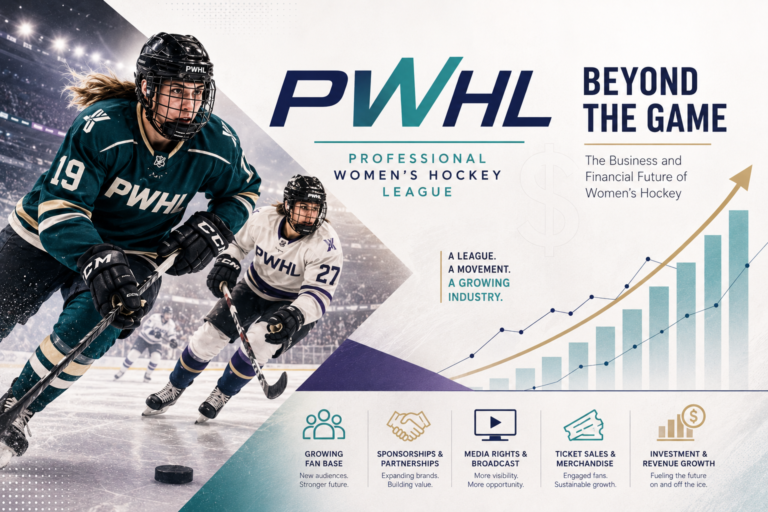
The Professional Women’s Hockey League is the newest and fastest-growing of the established leagues. Launched in January 2024 with six teams, it will field twelve teams in 2026–27 — a pace of expansion that took the NHL fifty years to match.
The PWHL’s salary structure is unusual: there is no traditional cap. Instead, each team must hit a minimum average salary per player — $58,349 in 2025–26, rising to $60,099 in 2026–27. The league minimum is $37,131.50, rising 3% annually. The highest-paid player, Ottawa’s Emily Clark, earned $126,090 in 2025–26 — a figure that is just 14.8% of the NHL minimum salary.
In May 2026, the PWHLPA made history by publicly releasing every player’s salary — the first time a professional women’s hockey league had ever done so collectively. The transparency itself was the story. When 65% of your league earns below its own average salary, sunlight is a form of leverage.
What separates the PWHL from every other league in this comparison is ownership structure. Mark Walter — the billionaire owner of the Los Angeles Dodgers — owns the entire league, every franchise. There is no fragmented ownership group to negotiate against. That single-owner model gave the league stability to expand aggressively without the franchise-level financial instability that has historically plagued women’s leagues.
WPBL — The Newcomer at the Table
Against this backdrop, the WPBL enters August 2026 with a $95,000 team salary cap, six teams, approximately $3 million in Series A funding, and no institutional backer.
The average player earns roughly $6,300 for the season. The league covers housing and gameday meals. Players receive an undisclosed share of sponsorship revenue. Beyond that, they are on their own.
By any comparison to the established leagues, those numbers are stark. But raw comparison misses the point. The better comparison is not “WPBL versus WNBA in 2026.” It is “WPBL in 2026 versus WNBA in 1997, NWSL in 2013, or PWHL in 2024.” That comparison is more complicated — and more honest.
Part Two: The Architecture of Pay — What the Structures Actually Have in Common
When you look across the salary structures of women’s professional leagues, a consistent architecture emerges regardless of the sport or the dollar amounts. Understanding that architecture is more useful than fixating on the gap between $6,300 and $300,000.
Structural Similarity 1: The Floor Is Always Political
In every league, the minimum salary is not set by market forces. It is set by collective bargaining, ownership philosophy, and institutional willingness to absorb losses in the short term.
The WNBA’s floor went from $15,000 (1997) to $64,000 (2025) to $300,000 (2026) — not because of organic revenue growth, but because of a negotiated CBA, a media rights windfall, and a player union that had finally accumulated enough leverage to demand more. The NWSL’s floor moved from $6,000 to $48,500 over twelve years of labour activism. The PWHL’s floor was written into the founding CBA before the first game was played — because the Walter Group had the financial capacity to guarantee it.
The WPBL has no floor yet. Its $95,000 cap is the entire structure. That is not inherently a failure; it is the condition of inception. The question is whether a floor gets written into a formal CBA before the league either grows or folds. Every league on this list had that conversation. Most had it badly, slowly, and under financial duress.
Structural Similarity 2: The Cap Reflects Revenue Confidence, Not Revenue Reality
The WNBA’s $7 million team cap in 2026 is not supported by current franchise revenue. Most teams reportedly still lose money. The cap is an investment in a projected future, underwritten by NBA owners whose losses are tax-efficient and reputationally convenient.
The NWSL’s cap is similarly forward-leaning — set at a level that forces some teams to take losses in the expectation that revenue follows investment in quality.
The PWHL’s required team average salary functions the same way: the Walter Group is subsidising the gap between what the league currently earns and what it needs to pay to keep elite players.
The WPBL’s $95,000 cap reflects the opposite condition: it is set at a level the league is confident it can actually fund. It is not aspirational. It is survivalist. That is not a criticism — a league that over-promises on salaries it cannot pay is more dangerous to players than one that underpays transparently. But it does mean the WPBL has not yet crossed the threshold its peers crossed when they started using the cap as a statement of intent rather than a ceiling of constraint.
Structural Similarity 3: Stars Are Paid in Platform, Not Just Salary
This is perhaps the most important structural parallel across every league in this analysis, and it runs directly through the WPBL.
In the WNBA, Caitlin Clark’s basketball salary is a footnote to her endorsement portfolio. In the NWSL, Trinity Rodman’s $2 million deal — the highest in league history — was enabled by a bespoke new rule written specifically for her. In the PWHL, Marie-Philip Poulin earns $110,000 from the league and a career’s worth of national hero status in Canada that translates into sponsorship and media work.
In the WPBL, Mo’ne Davis earns $6,300 from the league and a Wilson Sporting Goods deal that dwarfs it. Kelsie Whitmore’s value to the league is incalculable in sponsorship terms — she is the face of women’s baseball in America, a story that has been building since 2022. Ayami Sato brings five Women’s Baseball World Cup titles and an entire Japanese sponsorship market with her.
The platform-first model is not unique to the WPBL. It is the universal condition of early-stage women’s professional sports. Players accept below-market salaries in exchange for being first — first in a new league, first to prove a market exists, first to build a personal brand in a space with no incumbents. In the WNBA’s early years, players did the same thing. They were paid in belief and in the hope that the belief would eventually compound into money.
The difference is that in 2026, with women’s sports investment at an all-time high and brands actively competing for authentic women’s sports associations, the compounding happens faster than it did in 1997.
Part Three: The MLB Parallel — What the Numbers Hide
The most obvious comparison to reach for when analysing the WPBL is the gap between its $6,300 season and MLB’s $740,000 minimum salary. That gap — roughly 117 to 1 — is real and should not be minimised. But the more interesting comparison is structural, not numerical.
What the WPBL and MLB Actually Share
A seven-week season that mirrors the minor leagues, not the majors. The WPBL’s 2026 season is comparable in length to short-season minor league baseball — the kind of ball played by players in the lowest rungs of affiliated baseball, in rookie leagues and low Single-A. Minor League Baseball’s minimum salary as of 2025 is approximately $4,900 per month. A four-month season produces roughly $19,600. The WPBL’s $6,300 for seven weeks is in the same conversation — not identical, but not a different universe from where male professional baseball begins.
Sponsorship as the real economy. MLB superstars earn more from endorsements than from salary. Mike Trout’s Angels contract is the largest in MLB history, but his off-field income from Nike, Subway, and other brands generates additional millions annually. The WPBL’s top players operate by the same logic — the league salary is the floor, not the ceiling. Mo’ne Davis’s Wilson deal is not a supplement to her baseball income; it is her baseball income. The structure is identical to how MLB players at the lower rungs of the sport subsidise their playing careers with clinics, appearances, and sponsorships while they wait for the money to arrive.
A developmental arc that begins underpaid. No one in professional baseball — male or female — enters the sport at full market value. The entire minor league system exists to develop talent at below-market wages for three to eight years before a player reaches arbitration eligibility and eventually free agency. The WPBL’s inaugural pay structure is, in this sense, structurally analogous to where professional baseball has always started for men — with the crucial difference that men have a clear, codified escalation path. The WPBL does not yet have one.
The stadium ecosystem. The WPBL’s inaugural season is being played at Robin Roberts Stadium in Springfield, Illinois — a facility built for minor league baseball. The operational model is minor league baseball: regional markets, community-rooted fanbases, affordable ticket prices designed for families and casual fans. This is not coincidence. It is the most sustainable entry point into professional baseball economics, and it mirrors exactly how minor league baseball — now under MLB’s direct control — structures its business.
Where the WPBL and MLB Diverge Beyond the Numbers
The institutional escalation path. A minor leaguer who performs well gets promoted. The path from rookie ball to Triple-A to the major leagues is defined, contractual, and well-understood. A salary that starts at $4,900 per month in rookie ball can reach $740,000 at the MLB floor and tens of millions at the top. The WPBL has no equivalent escalation architecture. There is no WPBL equivalent of Triple-A, no direct pathway to a major league organisation, no rule protecting player rights as they ascend. The league has to invent that structure as it grows.
The collective bargaining infrastructure. The MLB Players Association is the most powerful sports union in American history. It negotiated free agency in 1975, reversed the reserve clause, and has protected player rights through nine decades of evolving baseball economics. The WPBL is too young to have a fully formed players’ association, too small to have meaningful collective bargaining power, and operating in a sport where women have had no professional infrastructure for 72 years. They are starting from scratch in a negotiating context that took MLB players forty years to build.
The ownership motivation. MLB teams are multi-hundred-million-dollar businesses whose owners are primarily motivated by franchise value appreciation and competitive performance. WPBL team owners in the inaugural season are, by the nature of the venture, primarily motivated by mission — by the belief that women’s professional baseball deserves to exist. That is a meaningful difference. Mission-driven ownership produces different decisions than profit-driven ownership. It can sustain a league through early losses that profit-motivated owners would not tolerate. It can also collapse suddenly if individual owners’ circumstances change.
Revenue diversification. MLB earns money from national television deals ($1.55 billion annually), local broadcasting rights, licensing, merchandise, international games, and a minor league system that generates its own revenues. The WPBL in Year 1 has none of those revenue streams at scale. It is, economically, a startup operating in a sport with a fully mature, multi-billion-dollar men’s counterpart — a dynamic that creates both opportunity (the fanbase already exists) and pressure (the comparison is always right there).
Part Four: The Pay Gap Nobody Talks About
When the sports media discusses the pay gap in women’s sports, it almost always frames the conversation as “women’s sport versus men’s sport” — WNBA versus NBA, NWSL versus MLS, PWHL versus NHL. That framing is real and important, but it obscures a second pay gap that is equally significant: the pay gap within women’s sports itself.
Consider what it means to be a player at different points on the women’s sports spectrum in 2026:
A veteran WNBA player with a Nike deal, a supermax contract, and a Caitlin Clark halo effect might earn $2 million or more this year — salary plus endorsements. A roster-minimum PWHL player in her first season earns $37,131 and a $1,700 monthly housing stipend, playing in front of sold-out arenas while earning less than a starting teacher’s salary in most US states. A WPBL player earns $6,300 for the season and counts herself lucky to be playing at all.
All three are professional women’s athletes in 2026. The distance between their economic realities is enormous.
This internal pay gap is not arbitrary. It reflects, fairly precisely, three variables: how long the league has existed, whether it has an institutional backer, and whether a star player has created a media moment that forced a revaluation of the entire league’s economics.
The WNBA had all three converge simultaneously in 2024 — a 28-year-old league, an NBA backstop, and Caitlin Clark. The PWHL had two of three — a wealthy single owner and three years of explosive growth, but not yet a transcendent star moment. The NWSL had twelve years and US Soccer’s partial support but no equivalent to Clark. The WPBL has none of the three — yet.
The implication for the WPBL is clear: the path to closing the internal gap in women’s sports runs through exactly the same variables. Time, institutional backing, and a star moment. The league can partially control the first by surviving. It can influence the second by proving a viable market to potential investors or MLB. The third is unpredictable — but the ingredients are on the roster.
Part Five: What the WPBL Needs to Learn From Its Predecessors
Every women’s sports league in this analysis made decisions in its early years that shaped its economics for decades. The WPBL is making those decisions right now, in real time, during an inaugural season. Looking at what worked and what didn’t across the WNBA, NWSL, and PWHL produces a short, blunt playbook.
What the WNBA did right: Survived long enough. Twenty-eight years of loss-making basketball, underpinned by NBA owners who kept the lights on, eventually produced the conditions for transformation. The WPBL cannot wait 28 years — it does not have an NBA — but the core lesson is durability. The leagues that made it were the ones that did not fold under early financial pressure.
What the NWSL did right: Made labour rights the foundation. The abolition of the draft, guaranteed contracts, and a formalised CBA created structural protections for players that outlasted individual ownership regimes. The WPBL should formalise a CBA — even a modest one — before financial pressure forces one under duress.
What the PWHL did right: Found one owner with deep enough pockets and long enough vision to underwrite the early years without requiring immediate returns. The Mark Walter Group’s willingness to expand to twelve teams in three seasons is only possible because one entity controls all twelve franchises and can absorb cross-subsidy losses that a fragmented ownership group could not. The WPBL needs to identify its equivalent — whether that is a deep-pocketed individual, a private equity consortium, or, eventually, a formal MLB partnership.
What the AAGPBL got wrong: Depended on individual team owners who had no long-term institutional commitment to women’s baseball. When the novelty wore off and MLB expanded to new markets in 1950, those owners had no reason to stay. The WPBL cannot afford to replicate that fragility.
Conclusion: $6,300 Is Not the Destination
The Women’s Pro Baseball League enters its inaugural season with the smallest salary structure of any major women’s professional league in North America. That is the fact. It is not, however, the story.
The story is that women’s professional baseball has been absent for 72 years — not because demand didn’t exist, but because institutional support didn’t. The story is that 600 women showed up to tryouts for a league that pays $6,300 a season, because $6,300 is more than zero, and zero is what professional women’s baseball paid from 1954 until now.
The story is that the WPBL sits at a moment in women’s sports when every comparable league — the WNBA, the NWSL, the PWHL — has demonstrated that the journey from startup salaries to professional wages is possible, and that the journey is getting shorter. The WNBA took 28 years. The PWHL doubled its team count in 3. The women’s sports investment boom of 2025–26 has compressed timelines in ways that were unimaginable a decade ago.
The $6,300 is a starting point. Whether it becomes $60,000, or $600,000, or a cautionary tale in a future retrospective on leagues that tried and failed, depends on decisions being made right now — by the WPBL’s founders, by its players, by MLB, and by the fans who show up in Springfield in August.
What is not in doubt is this: the women who take the field in 2026 are not being paid for what they are worth. They are being paid for what the market has been willing to acknowledge they are worth. Those are very different numbers. Every league in this analysis started with that gap. The ones that survived closed it.
The WPBL is trying to join that list. At $6,300 a season, it is exactly where every one of its predecessors began.