


For fifteen years, women have been playing professional tackle football in America — and paying for the privilege. Odessa Jenkins is the first person to build a serious business case for why that needs to change. Here is the full story.
Published: June 2026 | Category: Money & Power | Reading time: ~14 minutes
Introduction: A Question Nobody Asked
There is a moment Odessa Jenkins returns to often. It happened on a football field somewhere in Texas, years before she had a league of her own. A teammate mentioned to a New York Giants player that she played women’s professional football. He listened, nodded, and then asked the only question that made sense to him:
“Then why do you play?”
He wasn’t being cruel. He genuinely couldn’t understand it. You work a full-time job. You pay registration fees out of your own pocket. You buy your own equipment, arrange your own travel, cover your own medical bills when you get hurt. You practice at night after work and play on weekends. You do all of this at a professional level, against serious competition, in full pads, in front of real crowds — and at the end of the season, you receive nothing.
Not a minimum wage. Not a stipend. Nothing.
For Jenkins, that question — then why do you play? — became the one she spent the next decade trying to make obsolete.
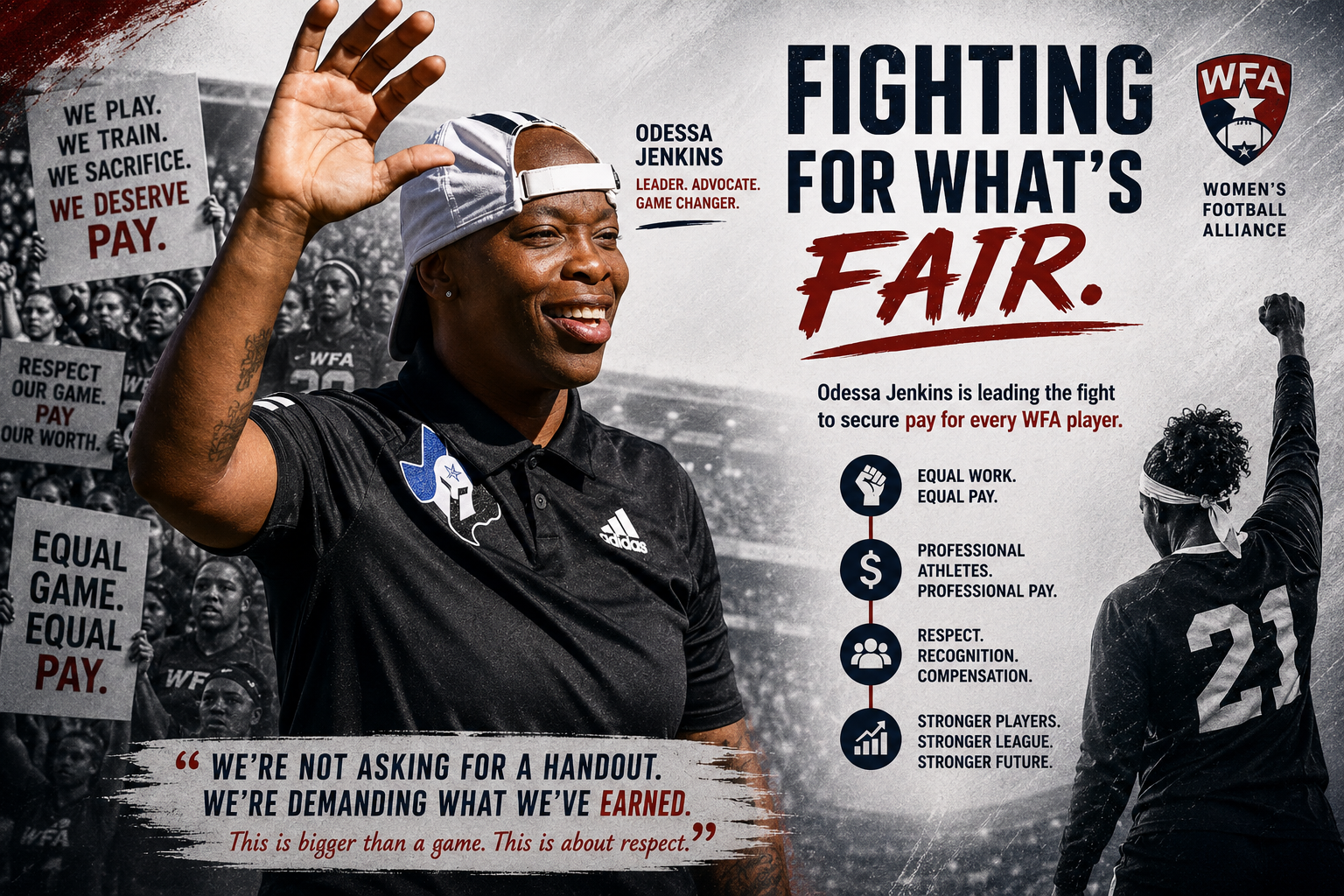
She is the founder and chairwoman of the Women’s National Football Conference, the largest professional women’s football league in America. She is a five-time national champion, a former Atlanta Falcons coaching intern, a tech executive, a two-time gold medalist representing Team USA, and the first Black woman to raise $1 million for a professional sports league. She grew up in South Central Los Angeles, lost her brother to gang violence, earned a Division I scholarship to Cal Poly on a basketball court, and somewhere in between all of that, fell in love with a sport that had no professional infrastructure for women and decided, almost alone, to build one.
The WNFC does not currently pay its players a salary. That fact is the centre of this story. But the more important fact — the one that makes this story worth telling — is that Jenkins is the only person in the history of women’s tackle football in America who has built a credible, funded, for-profit plan to change it.
This is the story of how she got here, what she’s up against, and whether it’s actually going to work.
Part One: The Problem She Walked Into
To understand what Jenkins is attempting, you first have to understand how thoroughly broken the economics of women’s tackle football have been — and for how long.
Women have been playing organised tackle football in America for over sixty years. The Women’s Football Alliance, the largest and longest-running league currently operating, has fielded teams since 2009. It now runs fifty-four teams across three divisions, broadcasts its Pro championship on ESPN2, has placed more than thirty players into NFL coaching and scouting positions, and operates an international programme spanning Central and South America, Europe, and Africa.
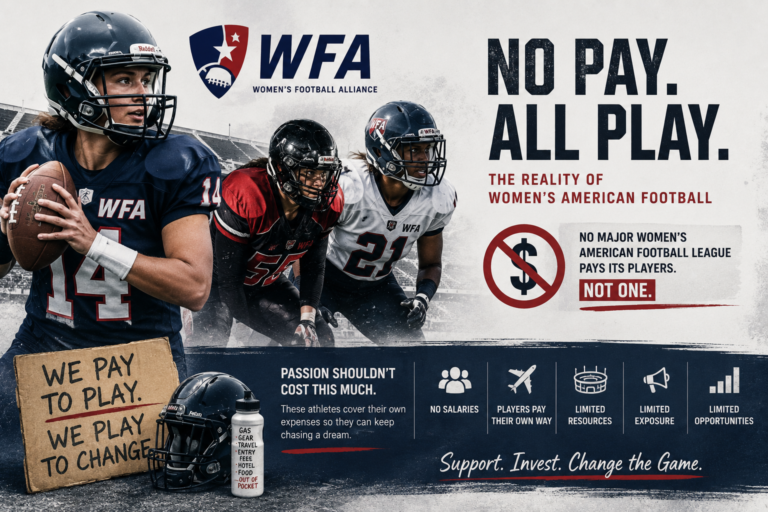
Its players earn zero salary.
The WFA’s model is explicit: players pay to participate. Registration fees run approximately $700 per season. Equipment, travel, and related costs bring the total annual outlay per player to between $2,200 and $2,500. The league’s $20,000-plus championship prize — divided across a forty-player roster — does not come close to closing the gap. Even a champion ends the season several thousand dollars in the hole. Injuries are covered by players’ own personal health insurance, because the league provides none. Medical costs from football-related injuries — torn ACLs, broken bones, concussions — fall entirely on the athletes themselves.
This is not a new problem. It is not a recent decline from better times. It has been the condition of women’s tackle football since the sport’s organised existence. The question is not why it persists. The structural reasons are clear enough: no institutional backer with deep pockets, no network television deal generating meaningful revenue, no single ownership entity absorbing losses across multiple seasons in pursuit of long-term viability.
The question is whether anyone can change it. For the first fifteen years of organised women’s tackle football, the answer was effectively no. Then Jenkins showed up.
Part Two: How She Got Here
Born in South Central Los Angeles, Jenkins lost her brother to gang violence before she was old enough to fully understand what that loss meant. She channelled everything she had into sport. By the time she graduated high school, she had earned a Division I basketball scholarship to Cal Poly San Luis Obispo, where she became a two-time Big West Conference Player of the Year. Basketball was her world.
Then she discovered football.
She entered women’s tackle football in 2008 — not as an experiment, but as a serious athletic pursuit. She was named the number one running back in the world, led Team USA to multiple international gold medals, and won two WFA national championships. She played for three different women’s tackle leagues. She understood the sport from the inside, at its highest level, for years.
And she understood, with the clarity of someone paying $700 registration fees out of her own tech executive salary, exactly what was broken about it.
Between her athletic career and the founding of the WNFC, Jenkins did something that sets her apart from almost every other figure in women’s tackle football: she built a career specifically designed to give her the tools to fix the problem. She spent a decade in healthcare technology with Medco Health Solutions and Express Scripts. She served as VP of Client Success at YourCause.com. She became President of Emtrain, an e-learning startup. She worked as head of business development at Parity. She learned how startups are built, how institutional investors think, how brands evaluate sponsorship opportunities, and how organisations scale.
Then, in 2017, she accepted an internship with the Bill Walsh diversity coaching fellowship. She joined the Atlanta Falcons coaching staff — one of the first women to hold an on-field internship position in the NFL — and spent nine weeks with the running backs under head coach Dan Quinn. She has said that period taught her everything about how a franchise is built from the inside: the film room culture, the organisational structure, the management philosophy.
She took all of that — the athletics, the business career, the NFL exposure — and in 2018, founded the WNFC.
When she started pitching the league to brands, she was direct to the point of audacity. She told them that within three years, the WNFC would have a hundred million eyeballs, a television deal, national press coverage, and sponsors writing real checks. They told her the world wasn’t ready for women’s tackle football. That she should aim smaller. Try a different sport.
One of those doubters is now a paying partner.
Part Three: What She Built
The WNFC launched its inaugural season in 2019. By 2026, it has become the largest professional women’s football league in America by revenue, profile, and institutional infrastructure — even while still paying its players nothing.
That contradiction is the heart of this story, and Jenkins does not shy away from it.
The league has secured sponsorships from Adidas, Riddell, Dick’s Sporting Goods, and United Sports Brands — making it the first women’s tackle football league ever sponsored by a major global sports brand. It has a broadcast partnership with Victory+ and a deal with Disney that brought its IX Cup Championship Game — the league’s equivalent of the Super Bowl — to ESPN2. The championship broadcast drew 150,000 viewers. The WNFC’s Instagram grew 61% in a single year. Its TikTok following doubled. Week one of the 2026 season showed a 40% jump in ticket sales across the league.
Revenue reached $1.1 million in 2025 — up approximately $500,000 year over year. For the first time in the history of women’s tackle football, a league is generating seven figures. It is still not enough to pay players.
The path to get here was not clean. Jenkins has spoken openly about the failures along the way: a multimillion-dollar streaming deal that paid out only $300,000. A second streaming partner that folded entirely. A business partner who ended up in prison. These are not footnotes — they are the texture of what building this league actually required. She absorbed those setbacks, recalibrated, and kept building.
The WNFC now fields 17 teams with 1,300 players drawn from more than 20 countries. Around 65% of those players identify as Black or Hispanic — a demographic fact Jenkins considers foundational, not incidental. The league’s nonprofit arm, Got Her Back, operates community programmes in places like Oakland and Watts, ensuring that Black and brown girls see a future in the sport long before they ever consider playing professionally. The WNFC, in Jenkins’s design, is simultaneously a sports property, a media platform, and a social infrastructure project. She has been deliberate about fusing all three.
Part Four: The Business Case for Paying Players
Here is where Jenkins’s tech executive background becomes the story’s most important element.
Every previous attempt to professionalise women’s tackle football — including the WFA itself — has operated on a model that is, structurally, incompatible with player salaries. The WFA is a nonprofit. Its franchise fees are deliberately kept low to maximise participation. The revenue that flows through the league is recycled into operations, travel stipends, equipment, and field rental — not player compensation. The model is designed for accessibility, not profitability. That is a choice with real consequences: fifteen years of operation, no player salary.
Jenkins made a different choice from the start. The WNFC is the first for-profit entity dedicated to women’s football. That is not an incidental detail. It is the foundational structural decision that makes everything else possible.
In November 2024, the WNFC closed a $1 million seed round led by ProPharma CEO Dawn Sherman — who also owns the WNFC’s Jersey Shore franchise, aligning investor and team owner incentives in a single figure. The round made Jenkins the first Black woman professional sports league founder to raise $1 million. It was the most money ever raised by a women’s tackle football organisation.
She is now working to raise $15 million more.
The capital allocation plan is specific. Part of the raise will fund sales and marketing infrastructure. Part will go into the league’s new flag football arm — a strategic move designed to capture the enormous momentum around women’s flag football ahead of its 2028 Olympic debut. Part will be used to build out a genuine franchise ownership model: currently, WNFC teams hold partnerships with the league rather than owning franchises outright, which limits the ability to attract the kind of owner-investors who would accelerate growth. And part — explicitly, publicly, in Jenkins’s own words — is going directly into players’ pockets.
The sequencing of that plan matters. Jenkins has not promised to pay players next season. She has built a three-step framework that she states clearly: establish the WNFC as a valuable sports property, break out of niche status, and then pay the players. That is a business case, not a charity appeal — and that distinction is the most important thing Jenkins has understood that every predecessor in women’s tackle football has missed.
She has been explicit about why the framing matters: “Before, it was like, ‘Oh, that’s cute. Women play football. Shouldn’t someone give them something?’ But we have to remind people that we are valuable assets. Our uniqueness makes us valuable, and we have to start presenting ourselves to the world as such.”
The WNFC is not asking for charity. It is asking for investment in a viable sports property that happens to have been systematically undervalued for sixty years. Those are fundamentally different asks, and they produce fundamentally different conversations with capital.
Part Five: What She’s Up Against
The optimistic reading of the WNFC’s trajectory is genuine. The revenue growth is real. The media traction is real. The demographic depth — 65% players of colour, 20-plus countries represented — gives the league a breadth that most women’s sports properties lack. The 40% ticket sales jump in week one of 2026 is the metric Jenkins points to most proudly, because it measures one thing above all others: whether people are willing to pay money to see women play tackle football. The answer, increasingly, is yes.
The harder reading is also real.
$1.1 million in annual revenue is not a foundation for salaries. Even if the entire revenue figure were redirected to player compensation — which it cannot be, because it also has to fund league operations, marketing, broadcast production, and everything else — divided across 1,300 players, it produces roughly $846 per person per season. That is less than what a WFA player currently pays in registration fees. It is a number that illustrates the scale of the gap between where the WNFC is and where it needs to be before a salary structure becomes viable.
The $15 million raise, if it closes, changes the conversation significantly. But that capital raise has not yet closed. The seed round took years of failed deals, a collapsed streaming partner, and a business partner’s imprisonment before it materialised. Fifteen million dollars is a different order of magnitude.
The comparison that hangs over everything is the WNBA. The women’s basketball league survived its early years — during which it also paid minimal salaries by any reasonable standard — because the NBA wrote the checks. Year after year of losses, absorbed by owners for whom the losses were tolerable. The WNFC has no equivalent. Jenkins is not working with an NFL franchise quietly underwriting the losses in the background. She is building the revenue base from scratch, with investment capital that has to generate returns.
That is the most dangerous structural difference between what Jenkins is attempting and what the WNBA’s founders actually did. And it is worth stating plainly: no women’s professional league in American sports history has reached sustainable salary-paying status without an institutional backer absorbing significant early losses. The WNBA had the NBA. The NWSL had US Soccer. The PWHL has Mark Walter’s ownership group. The WNFC has a $1 million seed round and a $15 million target.
Jenkins knows this. Her response — as stated across multiple interviews — is that the women’s sports investment landscape of 2026 is categorically different from anything that existed when those other leagues were founded. The WNBA got its Caitlin Clark moment in 2024. The PWHL tripled its team count in three years. Brand investment in women’s sports hit an all-time high in 2025. The WNFC is pitching into a market where the question is no longer whether women’s sports generates value. It is whether tackle football specifically can generate enough of it, fast enough, to build a salary structure before the runway runs out.
That is a real bet. It is not a guaranteed one.
Part Six: The Players Waiting
While the business case develops, the players keep paying.
There are 1,300 of them in the WNFC alone. Across the WFA, there are 2,100 more. Across all women’s tackle football leagues in America, there are several thousand women who wake up on Monday morning with sore bodies and full-time jobs to get to, who spent their weekend playing professional football in front of real crowds for no pay, who will do it all again next week because the alternative is not playing at all.
Their occupations span every professional category: project managers, IT specialists, nonprofit directors, EMTs, marketing managers, healthcare workers. They are, in many cases, accomplished professionals in their day jobs — and they subsidise their football careers with those salaries. The sport works only because these women have decided it is worth the cost.
Jenkins has been direct about what that sacrifice means and what it demands of anyone who wants to claim this is a professional league: “Money is validation. Step one is establishing we are valuable enough to pay players.” She is not saying players deserve charity. She is saying that a sport that asks women to pay to participate is not yet professional in any meaningful sense — and that changing that requires building an enterprise, not running a nonprofit.
The flag football arm Jenkins is building alongside the tackle league is also part of the calculation. Women’s flag football is headed to the 2028 Olympics. The NFL is investing in it heavily. The audience it will generate — particularly among younger fans and communities where tackle football has lower cultural penetration — is potentially transformative for the WNFC’s total revenue base. If Jenkins can build the dominant women’s flag football league alongside the tackle product, the combined revenue picture looks different. Not immediately. But different.
The Bottom Line
Odessa Jenkins is trying to do something that has never been done in the history of women’s tackle football in America: build a for-profit sports league, raise institutional capital, achieve mainstream broadcast and sponsorship reach, and use that commercial infrastructure to pay the athletes who make the whole thing possible.
She has gotten further than anyone before her. The ESPN deal, the Adidas partnership, the $1 million raise, the seven-figure revenue, the 40% ticket sales jump — these are not cosmetic achievements. They are the early evidence of a viable business model that did not exist five years ago.
She has not yet crossed the threshold that matters most. The players are still paying to play. The $15 million raise has not closed. The gap between $1.1 million in annual revenue and the amount needed to pay 1,300 players a meaningful salary is still enormous.
But here is what is also true: in every other sport in this analysis — basketball, soccer, hockey, baseball — the gap between “women pay to participate” and “women get paid to play” was eventually closed. It was closed slowly, badly, under financial duress, with institutional help that Jenkins does not have. It took decades. And it required, in every case, someone willing to build the infrastructure before the money arrived.
Jenkins is building the infrastructure. The money has not yet fully arrived.
Whether it does — and whether it arrives fast enough, in enough volume, to convert a pay-to-play league into a salary-paying one — is the open question that the next two to three years will answer. The 2028 Olympics, the flag football boom, the $15 million raise, the continued growth of women’s sports investment: all of these are variables pointing in the right direction.
The question Jenkins started with — then why do you play? — still has no financial answer. She has spent seven years building toward the day it does.
She is not there yet. But she is closer than anyone who came before her. And in women’s tackle football, that is not nothing. That is everything.