


In 2026, women’s tackle football players are suiting up for nationally televised championships, building NFL pipelines, and absorbing career-ending injuries — all while writing checks to participate. Nobody seems bothered enough to fix it.
Published: June 2026 | Category: Investigative | Reading time: ~7 minutes
Here is a number that should make you angry: zero.
That is what a Women’s Football Alliance player earns for a full season of tackle football. Eight regular season games. Three practices a week starting in January. A postseason. A nationally televised championship on ESPN2 watched by 174,000 people.
Zero dollars.
Now here is a second number: $2,500.
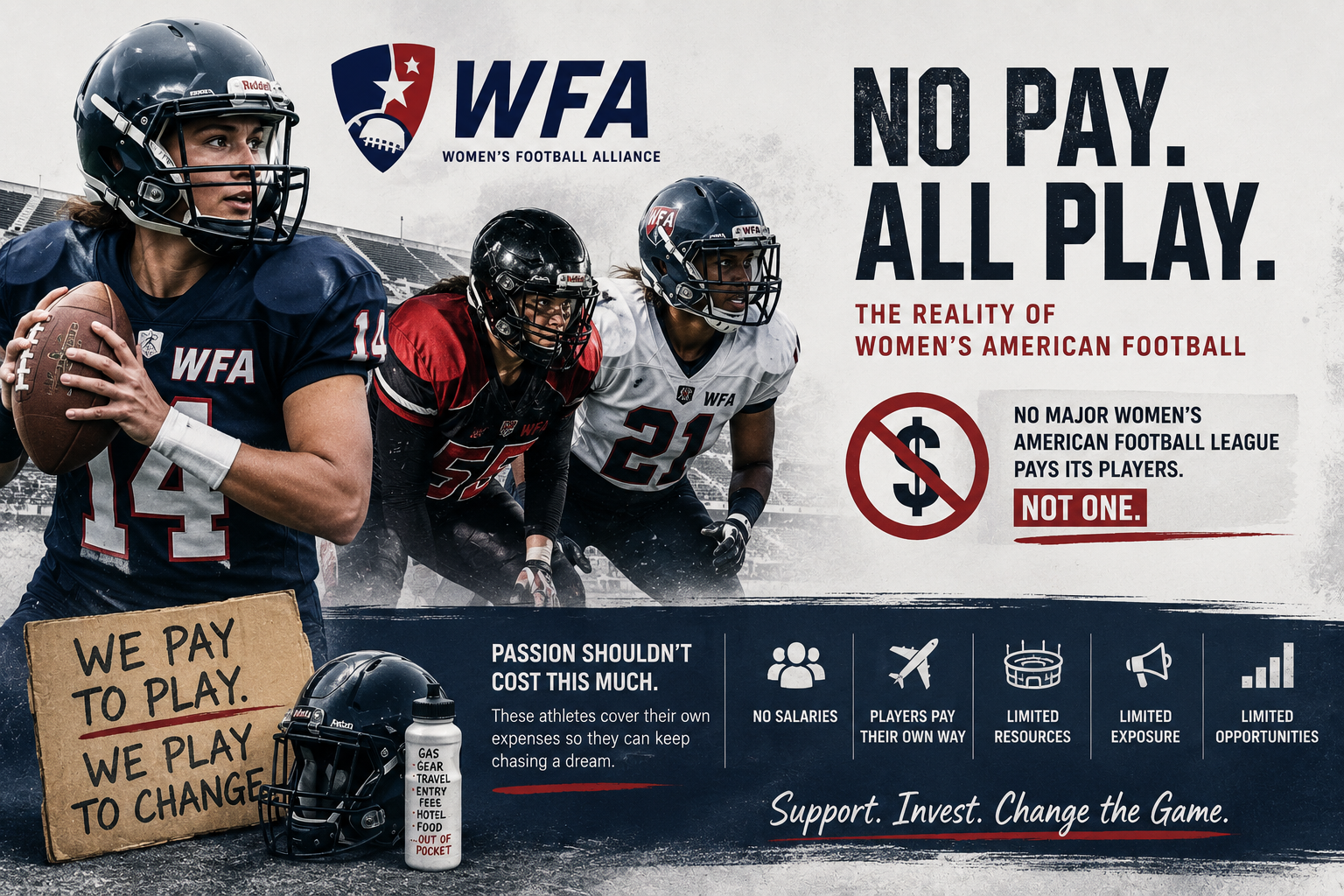
That is roughly what she pays — out of her own pocket — for the privilege of doing it. Registration fees. Equipment. Travel. And if she gets hurt, which in full-contact tackle football is not a question of if but when, she reaches into her own health insurance and covers that too. Unlike every NFL player on earth, there is no league, no team, no institution standing behind her with a medical bill.
In 2026 — the same year the WNBA minimum salary crossed $300,000, the same year the PWHL published a full salary disclosure for 194 players, the same year women’s sports investment hit an all-time high — the women playing America’s most-watched sport are net negative every single season they lace up.
This is not a niche problem. The WFA is the largest women’s tackle football league in the world, with 54 teams across three divisions. The WNFC has 17 teams and 1,300 players. Together, they represent thousands of women playing the highest level of professional women’s football in America. None of them are paid. Not one.
The Ecosystem Nobody Is Talking About
Women’s tackle football has been played seriously in the United States for over twenty years. The WFA was founded in 2009. The WNFC launched in 2019. Both have grown steadily, both have landed ESPN deals, and both have produced athletes who have gone on to reshape the sport at its highest levels — over fifteen WFA veterans have moved into full-time NFL coaching and scouting positions, including coaches currently working in the league.
Read that again. Women who played tackle football for free, paying their own way through season after season, are now coaching in the NFL. The sport they subsidised with their own money produced the credentials that opened a door into a billion-dollar industry. That door does not swing back. The NFL did not write them a check. The WFA did not cut them in. They built the bridge and then watched other people walk across it.
The league’s response to all of this is, charitably, a shrug. The WFA’s non-profit model was designed to keep franchise fees low — 70% cheaper than rival women’s leagues at founding — which made it accessible and helped it grow. It also made player salaries structurally very difficult to generate. The math was built to expand the sport, not to compensate the athletes expanding it. Fifteen years later, that math has not changed.
What “Support” Actually Looks Like
When the WFA talks about player compensation, the language shifts carefully. Some costs, the league says, are covered by sponsors. Wilson. Ticket sales. Licensing rights. The team membership fee of $1,000 to $2,000 per season covers liability insurance, game balls, film, and travel stipends for the playoffs and national championship.
What it does not cover: regular season travel, which is on the teams. Personal equipment — pads, helmets, cleats. The $700-plus registration fee each player pays individually. And medical costs, which belong entirely to the player and her insurance provider.
The WFA championship prize is “over $20,000 in rewards” — the only money in the league that flows toward players rather than away from them. Divided across a forty-player championship roster, that is roughly $500 per person. A player who wins everything, who goes undefeated, who lifts the trophy on ESPN2 in front of 174,000 viewers, is still roughly $2,000 in the hole for her season.
Winning is not a financial strategy. It is barely a consolation prize.
The WNFC Knows It Is Broken
To be fair to the people running women’s football, at least one of them is saying the quiet part out loud.
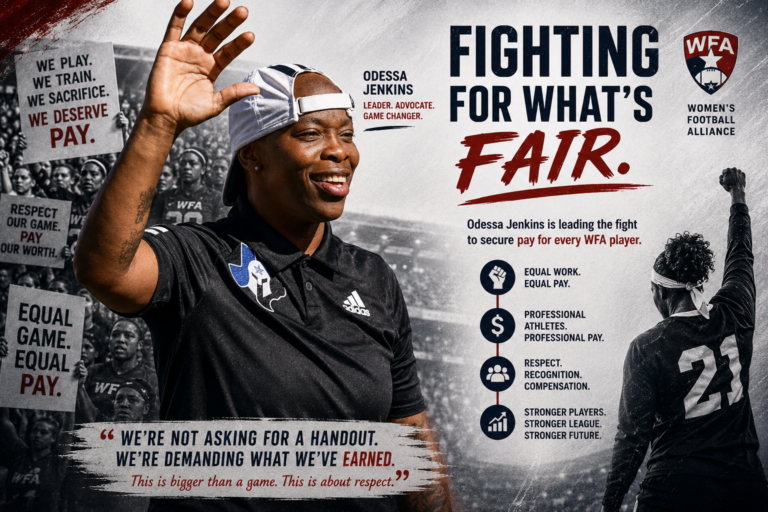
Odessa Jenkins founded the Women’s National Football Conference in 2019 after playing for the WFA for years — paying her own way through multiple championships, watching sponsors circle the sport without the money ever reaching the field. The WNFC became the first for-profit entity in women’s tackle football. It landed Adidas, Dove, and Riddell as sponsors. It put its championship on ESPN2. It generated $1.1 million in revenue in 2025 — up $500,000 from the year before.
And none of it went to players.
Jenkins is not pretending that is acceptable. “Money is validation,” she has said publicly. “Step one is establishing we are valuable enough to pay players.” The WNFC raised $1 million in seed funding in late 2024. Jenkins is now pursuing $15 million in further capital — explicitly to fund player salaries — and has called paying players the league’s primary growth objective.
That honesty is meaningful. It is also, after five seasons and 1,300 players who have not earned a dollar, somewhat overdue.
The WNFC’s revenue model is real and growing. Its viewership numbers are real. Its social media engagement doubled year-over-year in 2025. The pipeline to paying players exists — it just has not been opened. Whether Jenkins gets the $15 million she needs, and whether it actually reaches the players if she does, are the two questions women’s football cannot answer yet.
The Comparison That Should Embarrass Everyone
Consider the landscape of women’s professional sports in America right now.
The WNBA minimum salary is $300,000 in 2026 — a number that would have been unthinkable five years ago, driven by a new CBA, a $2.2 billion media deal, and the arrival of Caitlin Clark. The NWSL minimum is $48,500. The PWHL minimum is $37,131, and the league just publicly disclosed every player’s salary for the first time in women’s hockey history. Even the WPBL — the Women’s Pro Baseball League, which played its inaugural season in August 2026 — pays its players $6,300 for a seven-week season. That number is embarrassingly small. It is also infinity times more than what a WFA player earns.
The women playing tackle football are not playing a lesser sport. They are playing America’s sport — the same game, the same rules, the same violence, the same injuries. They are doing it in front of real audiences on real television networks. The 2023 WFA championship drew more viewers than many WNBA regular season games drew in that same period. The WNFC’s IX Cup pulled 150,000 viewers in 2025.
The viewership exists. The interest exists. The ESPN contracts exist. The athlete quality — producing NFL coaches and scouts — clearly exists.
What does not exist is the will to pay the people making it happen.
Why This Keeps Not Getting Fixed
The structure of women’s tackle football makes the salary problem harder than it looks from the outside, but not as hard as the leagues sometimes imply.
The WFA’s non-profit model is the central constraint. Non-profit status is not inherently incompatible with paying athletes — plenty of non-profit organisations pay their performers — but the WFA’s specific financial architecture, built around low franchise fees and community-level budgets averaging $20,000 per team, leaves almost nothing to redistribute. The league was designed to survive, not to thrive. It has survived for fifteen years. At some point survival stops being an excuse and starts being a choice.
The WNFC’s for-profit model removes that excuse. Jenkins built the WNFC specifically to generate the kind of revenue that could eventually reach players. The league is generating seven figures. It has brand partners most women’s sports leagues would envy. The gap between “generating revenue” and “paying players” is, at this point, a decision — not a structural barrier.
The deeper problem is a mindset that has calcified across women’s tackle football over decades: the idea that playing is the reward. That access to the sport — the pads, the film sessions, the championships — is compensation enough. That the women suiting up every spring understand the economics and have made their peace with them.
Some of them have. Many of them have not. And the women who cannot afford the $2,500 annual cost — who love football but cannot write that check — are simply not playing. They are the athletes nobody talks about, the ones the league never counts, because they never made it through the financial barrier to be counted.
What Needs to Happen
Women’s tackle football does not need a saviour. It needs an honest conversation about what it has built and what it owes the people who built it.
The WFA has a television deal, a national brand, and fifteen years of institutional legitimacy. It also has a financial model that has not evolved in fifteen years. The non-profit structure that made the league accessible in 2009 is now the ceiling on what it can become. At some point the choice between keeping franchise fees low and paying athletes has to be made consciously — not avoided indefinitely.
The WNFC has the right framework and the right intentions. Jenkins is the most important person in women’s tackle football right now precisely because she is the only one publicly insisting that “we’ll pay players eventually” is not a strategy. The $15 million raise she is pursuing is not guaranteed. The timeline is not guaranteed. But the direction is right.
The women currently paying $2,500 a season to play tackle football on ESPN do not have time for eventually.
They have already paid enough.