


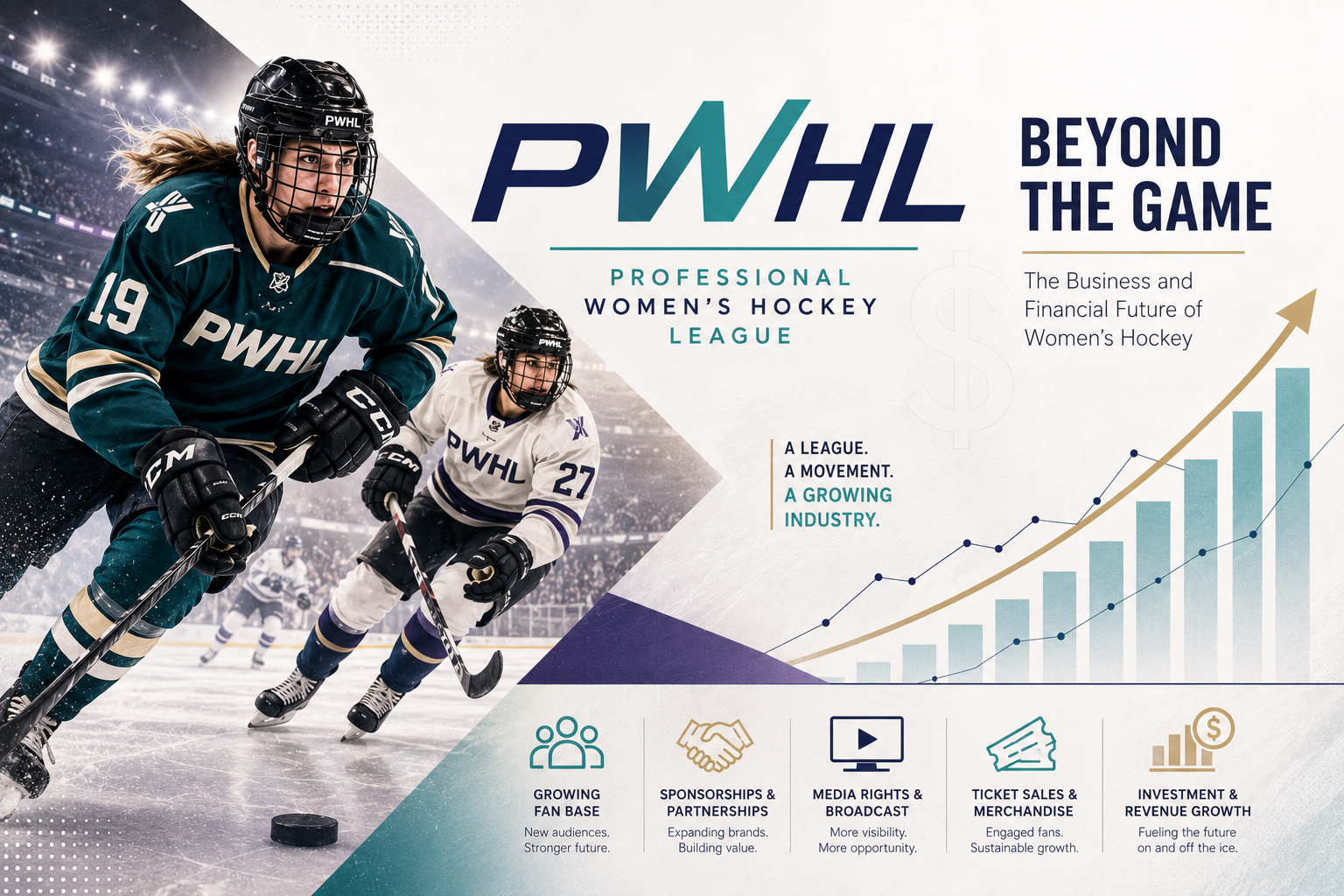
The Professional Women’s Hockey League just became the first women’s hockey league in history to publicly disclose every player’s salary. The range runs from $37,131 to $126,090. Neither figure is what it appears to be.
Published: June 2026 | Category: Money & Power | Reading time: ~12 minutes
Introduction: A Number That Changes the Conversation
On May 12, 2026, the Professional Women’s Hockey League Players’ Association did something no women’s hockey organisation had ever done before: it published every player’s salary.
All 194 of them. Down to the dollar.
The range ran from $37,131.50 — the league minimum — to $126,090, earned by Ottawa Charge forward Emily Clark. The PWHLPA’s executive director Malaika Underwood framed it as a matter of principle, saying the disclosure was designed to give players “clearer information and stronger context in individual negotiations, while also supporting a more transparent and credible marketplace for the league overall.”
It was a remarkable act of institutional honesty. Most professional sports leagues — men’s or women’s — fight to keep salary information out of the public domain. The PWHL went the other direction entirely.
And yet, the numbers the disclosure revealed are more complicated than the headlines suggested. The highest-paid player in the league earns less than one-seventh of the NHL minimum salary. The best player in the world — by most reasonable assessments — is only the fifth-highest earner. More than half the league earns below $50,000. And the player currently sitting at the top of the salary list will not be in the top 40 next season.
This is the PWHL salary story. Not the one-line version, but the whole thing.
Part One: What the Numbers Say
Let’s start with the raw data, because it matters.
The 2025-26 PWHL season featured 194 players across eight teams. The complete salary breakdown, accurate as of April 12, 2026, shows the following:
The top ten earners: Emily Clark (Ottawa) led at $126,090, followed by Sarah Fillier (New York) at $125,000, Brianne Jenner (Ottawa) at $122,003, Abby Roque (Montréal) at $116,699, and Marie-Philip Poulin (Montréal) at $110,216. Renata Fast and Hilary Knight each earned $106,090. Gabbie Hughes and Megan Keller both earned $105,000. Kendall Coyne Schofield rounded out the six-figure club at $100,785.50 — the only player in the league to earn exactly that amount.
Ten players earning six figures. Out of 194.
The bottom of the distribution is where the story gets harder. Ninety-seven players — exactly half the league — earned less than $50,000 in 2025-26. Seventeen players earned the league minimum of $37,131.50. Reserve players received a stipend of no less than $15,000 for the season.
The average salary across all 194 players was $56,650. The league’s champion, Montréal Victoire, averaged just under $58,000 per player — a figure that includes Poulin, Roque, and Ann-Renée Desbiens, three of the most decorated women’s hockey players alive.
To put those numbers in the context they deserve: the NHL minimum salary in 2025-26 was $775,000. The average NHL salary was $3.82 million. The best player in the PWHL earned $126,090 — 16.3% of what the worst-paid player on the worst NHL team earns as a contractual floor. The average PWHL salary is 1.48% of the average NHL salary.
That gap is not a rounding error. It is a structural reality that the PWHL has to navigate — and, to its credit, is navigating faster than almost anyone in women’s sports has managed before.
Part Two: The Numbers Behind the Numbers
Here is what the salary disclosure did not tell you — and why the headline figures are only part of the story.
Emily Clark Is Not Actually the Highest-Paid Player Going Forward
Clark’s $126,090 salary made her the league’s top earner in 2025-26. It will not make her a top-40 earner in 2026-27.
Clark signed a front-loaded deal — a structure common in salary-cap sports, where a player accepts higher pay in the early years of a contract in exchange for lower pay in the later years, giving the team financial flexibility in the process. Next season, Clark’s salary drops to $82,910, a reduction of $43,180. Ottawa structured the deal specifically to create cap space to pursue free agents in the 2026 offseason while still compensating Clark at a higher rate while her current teammates were in place.
It is a sophisticated piece of contract engineering for a league that is only three seasons old. The fact that it exists at all says something important about how quickly PWHL teams have learned to work the salary architecture.
Clark’s situation is not unique. Sarah Fillier, the second-highest earner at $125,000, is also on a front-loaded deal that will see her drop to $110,000 in 2026-27 — a $15,000 reduction. Neither reduction represents a failure or a dispute. Both reflect deliberate team-building strategy.
The Greatest Player in the World Is the Fifth-Highest Earner
Marie-Philip Poulin is, by almost universal agreement, the most decorated women’s hockey player of all time. Two Olympic gold medals — both decided by her own goals. Multiple World Championship titles. A Walter Cup in her first PWHL season. A 2025-26 Walter Cup championship with Montréal. She is the player Canadian hockey culture has rallied around for fifteen years.
Her 2025-26 salary: $110,216.
Poulin earned fifth in the league — behind Clark, Fillier, Jenner, and Roque. That is not a slight against those players. It reflects something more fundamental: in a young league operating on constrained finances, even the greatest player in the sport’s history cannot command market-rate compensation. The market does not yet exist at that scale.
What Poulin did earn, beyond her salary, was a Walter Cup ring, a playoff MVP award, and the kind of institutional legacy that is already being written into hockey history. Those things are real. They are not mortgages.
The Montréal Model: Building a Champion on $58,000 Average
When Daniele Sauvageau, Montréal’s general manager, extended the Victoire’s three foundational stars — Poulin, Ann-Renée Desbiens, and Laura Stacey — it came with a significant ask, according to reporting from The Hockey News. The players accepted, collectively, a structure that prioritised team depth over individual maximisation. Montréal’s championship-winning roster averaged just under $58,000 per player — essentially at the league average, with no one dramatically above the pack.
It is a management philosophy borrowed from salary-cap sports everywhere: distribute resources evenly enough to prevent roster holes, compensate stars fairly enough to retain them, and build team identity around winning rather than individual earnings.
That Montréal won the Walter Cup with that approach suggests the philosophy worked. It also suggests something broader: in a league where the salary ceiling is $126,090, the competitive advantage does not come from outspending your rivals. It comes from outthinking them.
Part Three: A League Moving Faster Than Any That Came Before
Salaries do not exist in isolation. They are a function of revenue, and revenue is a function of growth. To understand where PWHL pay is going, you have to understand how fast the league is moving.
The PWHL launched on January 1, 2024, with six teams — the so-called “Original Six” of Boston, Minnesota, Montréal, New York, Ottawa, and Toronto. In its inaugural year, it was named the Sports Business Journal’s Sports Breakthrough of the Year and ranked number one in Canada for corporate reputation according to the Harris Poll.
In 2025-26, it expanded to eight teams, adding Seattle and Vancouver. Attendance grew significantly. The league’s Takeover Tour — neutral-site games designed to test new markets — drew 16,012 fans to Hamilton, Ontario, in January 2026, with over 70% of ticket buyers purchasing their first-ever PWHL game. That is not an existing fanbase being retained. That is a new fanbase being created in real time.
Then, in May 2026, the league announced its second expansion class: Detroit, Hamilton, Las Vegas, and San Jose. Four teams in a single announcement, bringing the league to twelve franchises for the 2026-27 season. The San Jose franchise — the last to be confirmed — came with a remarkable footnote: the Golden State Valkyries of the WNBA had already established that the Bay Area market supports women’s professional sports at scale, leading the WNBA in attendance with over 18,000 fans per game at Chase Center.
To contextualise that expansion pace: it took the NHL fifty years to grow from four to twelve teams, between 1917 and 1967. The WNBA reached twelve teams in two years — but six of those franchises folded by 2009, a cautionary tale about expansion outrunning viability. The NWSL spent nine years growing from its 2013 launch to twelve teams in 2022. The PWHL will accomplish the same in three seasons.
Whether that pace is sustainable is the legitimate question. The league’s answer — through its spokesperson — is that the expansion “is a direct response to the demand we’ve seen.” The Hamilton market alone received nearly 2,000 season ticket requests within hours of the team announcement. Las Vegas and San Jose come with ready-made women’s sports audiences in cities where the WNBA is already proving the concept.
The counterargument — that aggressive expansion has historically preceded contraction in women’s leagues — is real and deserves to be stated. The WNBA’s early 2000s collapse after rapid expansion is the cautionary data point nobody at the PWHL wants to repeat. The league appears aware of this. The six-phase expansion player distribution process announced in May 2026 reflects an attempt to manage roster construction carefully across twelve teams rather than simply flooding the market with diluted talent.
Part Four: The Structural Architecture — What Makes the PWHL Different
Understanding the PWHL’s salary structure requires understanding two things about it that are genuinely unusual in professional sports: its ownership model and its cap design.
One Owner, Twelve Teams
The PWHL is owned entirely by the Mark Walter Group — the same ownership consortium that owns the Los Angeles Dodgers. There are no individual franchise owners negotiating with a league office. Walter’s group owns every team. Every ticket sold, every sponsorship signed, every media deal negotiated flows through a single ownership entity.
This is structurally unusual in North American professional sports, and its implications for player compensation are significant. A fragmented ownership group — twelve independent franchise owners each managing their own P&L — will always have at least some owners reluctant to increase the league minimum, because it directly reduces their own franchise’s margin. A single owner can absorb cross-subsidy across teams more easily, can make long-term investment decisions without individual franchise resistance, and can set salary floors that reflect aspiration rather than the lowest common denominator.
It is not coincidental that the PWHL has the fastest expansion trajectory and the most stable labour environment of any women’s professional league currently operating. It has an owner who has decided, strategically, that investing in women’s hockey is worth the short-term losses. That decision is the structural foundation beneath every other positive development the league has achieved.
No Salary Cap — A Required Average Instead
The PWHL does not have a traditional salary cap. Instead, each team must meet a minimum average salary per player — set at $58,349 in 2025-26 and rising to $60,099 in 2026-27. The league minimum rises 3% annually under the current CBA.
This is a meaningful design difference from the WNBA or NWSL model. A cap sets a ceiling on what teams can spend. A required average sets a floor on what teams must spend — but leaves the ceiling open. In theory, a team could pay its stars dramatically more than $126,090 if it wanted to, as long as the roster average clears the threshold.
In practice, the league is still early enough in its economic development that no team has tested that ceiling. But the architecture matters. It means the PWHL’s salary structure is designed to grow upward without formal constraint, rather than being held in place by a cap that requires a full renegotiation to raise.
Part Five: The Gap That Remains
All of the above — the transparency, the growth, the thoughtful cap architecture, the expansion momentum — exists alongside one inescapable fact: the PWHL’s best-paid player earns less than 16% of the NHL’s minimum salary.
That gap is not closing quickly.
The 3% annual increase in the league minimum — from $37,131.50 in 2025-26 to $38,245 in 2026-27 — is meaningful to the players at the bottom of the salary distribution, but it is not the kind of step-change that moves the needle on the overall gap. The WNBA’s equivalent breakthrough came from a single CBA negotiation that increased the minimum by over 350% in one agreement. That negotiation was enabled by a media rights deal ($75 million annually) and a cultural moment (Caitlin Clark) that forced the economics to reset entirely.
The PWHL’s equivalent moment has not yet arrived. The league does not have a national broadcast deal in the United States at the scale of the WNBA’s. It does not yet have a Caitlin Clark — a single transcendent talent whose presence transforms the commercial conversation. Marie-Philip Poulin is one of the greatest athletes in the history of her sport, but she has been doing this for fifteen years. The media moment that resets everything tends to be a new arrival, not a veteran hero.
What the PWHL has, more than any women’s professional league currently operating, is structural momentum. Twelve teams. A single committed ownership group. A salary transparency initiative that gives players real negotiating leverage for the first time. An expansion into markets — Las Vegas, San Jose — where women’s sports have already demonstrated commercial viability. And a fanbase that, judging by the Hamilton Takeover Tour numbers alone, is still being discovered rather than exhausted.
The salary gap between the PWHL and NHL is enormous and real. It is also, based on the available evidence, narrowing in the right direction — and doing so faster than most observers expected when the league played its first game eighteen months ago.
Part Six: What Comes Next
The PWHL’s four-team expansion for 2026-27 will test the league’s fundamentals in ways the first three seasons did not. Twelve teams means more games, more roster spots, more player salaries to fund, more markets to develop, and more pressure on the league’s single ownership structure to sustain short-term losses in multiple new cities simultaneously.
It also means more leverage in the next CBA negotiation. More players means a bigger union. More teams means more revenue to argue over. More markets means more data to demonstrate commercial viability.
The players released their salary data as a strategic move, not a charitable one. By establishing a public baseline — here is what every player earns, on the record — they have changed the dynamic of every future contract negotiation in the league. A player who knows her comparable earns $90,000 negotiates differently than a player guessing in the dark. Malaika Underwood’s framing of the disclosure as a tool for “stronger context in individual negotiations” was precise language. It was a power play executed with a spreadsheet.
The next CBA — whenever it arrives — will be negotiated in a fundamentally different information environment than the last one. The players will know the numbers. The league will know the players know. The question is whether the revenue growth between now and then creates enough room to have the conversation the PWHL’s best athletes deserve.
Based on the pace of the last three years, there is reason to believe it will.
The Bottom Line
The PWHL salary disclosure of May 2026 was historic for its transparency. It was honest about the gaps and honest about the complexity within the numbers. It revealed a league where the champion wins on $58,000 average salaries, where the greatest player in the sport earns $110,216, and where front-loaded deals and strategic pay cuts are already being used to build winning rosters within a system that is still finding its financial footing.
None of those numbers are where they need to be. All of them are higher than they were eighteen months ago. And the trajectory — twelve teams, a single deep-pocketed owner, an empowered players’ union, and a fanbase that is still being discovered — points upward.
That is not a guarantee. Women’s leagues have been pointing upward before and found the floor. But the PWHL has structural advantages — ownership stability, labour transparency, and timing — that its predecessors did not.
The numbers will need to catch up to the ambition. The ambition, at least, is clearly there.