

The IWL has a promotion pyramid, a continental pathway, and a dominant champion. What it still doesn’t have is the crowds — or the pay — that would make it truly professional.
Global Game | June 2026
The League Nobody Sees Coming
Ask most Indian sports fans what women’s football in India looks like in 2026 and they’ll tell you about the national team. Manisha Kalyan. Bala Devi. The AFC Asian Cup. They won’t mention the Indian Women’s League.
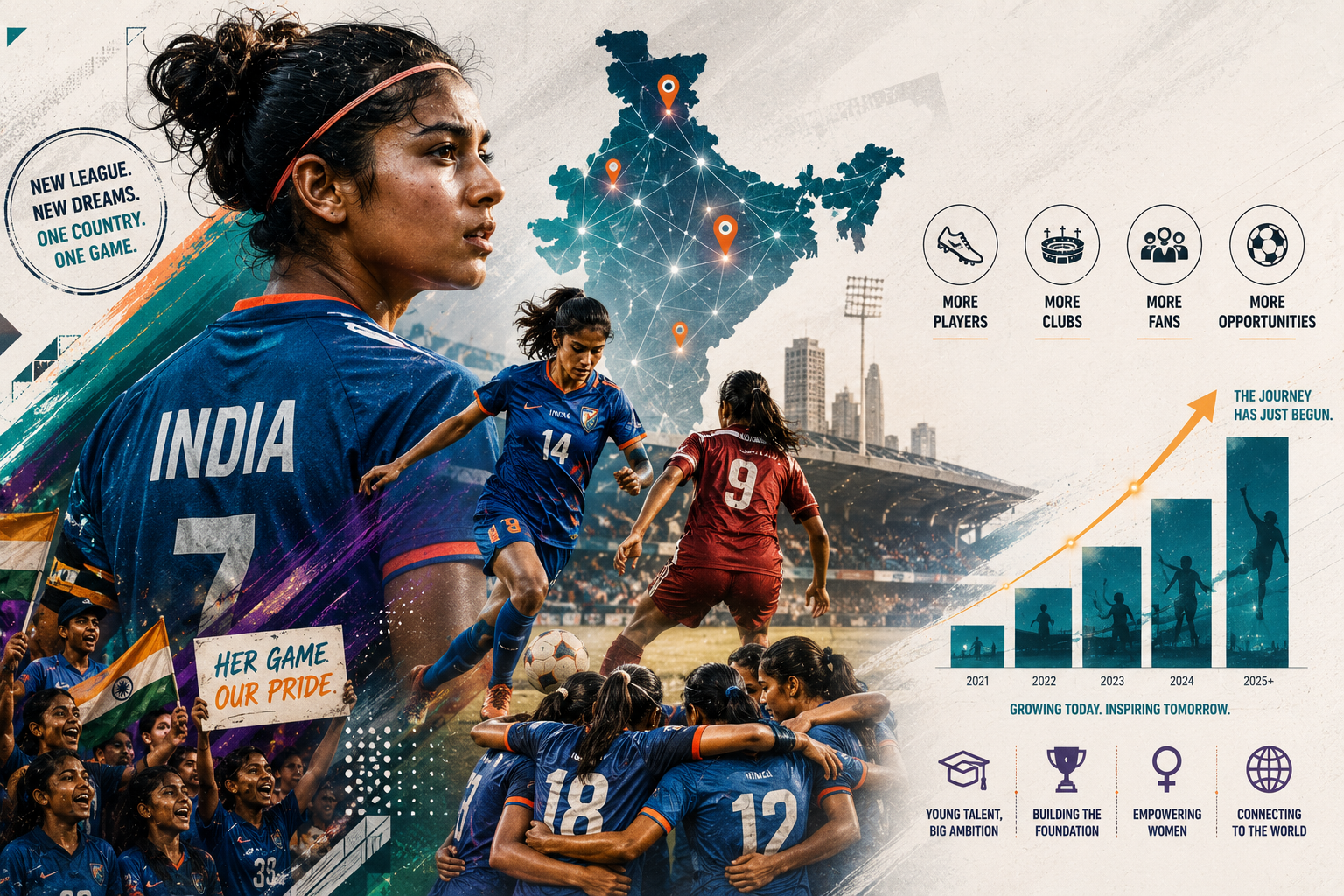
That’s the gap the IWL hasn’t closed yet. The structural story of the league — nine seasons old, a promotion and relegation pyramid now in place, an AFC Women’s Champions League berth for the domestic champion, and a quality level rising visibly every season — is genuinely compelling. The mainstream audience hasn’t found it. Those two facts are the IWL’s defining tension in 2026, and understanding them properly means understanding what Indian women’s football is building toward, and how much runway it still needs.
What the League Actually Is
The IWL is the top tier of women’s football in India, run by the All India Football Federation. Eight clubs compete across two phases each season. The champion qualifies directly for the AFC Women’s Champions League — Asia’s premier club competition — meaning the IWL is no longer just a domestic title race. It is a continental qualifier.
Below it sits IWL 2, the second-tier league launched in 2023, which connects state league football all the way up to the top flight through promotion and relegation. That two-tier structure is newer than most people realise. Promotion and relegation between the two divisions only arrived in the 2024-25 season. Before that, the pathway from grassroots football to the IWL was informal at best.
The clubs themselves range from established football institutions to newer academy-based operations. Gokulam Kerala FC from Kozhikode dominated the early years of the league, winning three consecutive titles between 2019 and 2023 and representing India in the AFC Club Championship. Odisha FC won the first season played in a home-and-away format in 2023-24. And then East Bengal arrived.
The East Bengal Story
In the context of Indian football, East Bengal needs no introduction. One of the two great clubs of Kolkata and arguably the most supported football club in Eastern India, East Bengal’s men’s side has been a fixture in Indian football for over a century. The women’s side is considerably newer — and considerably more successful, at least by recent standards.
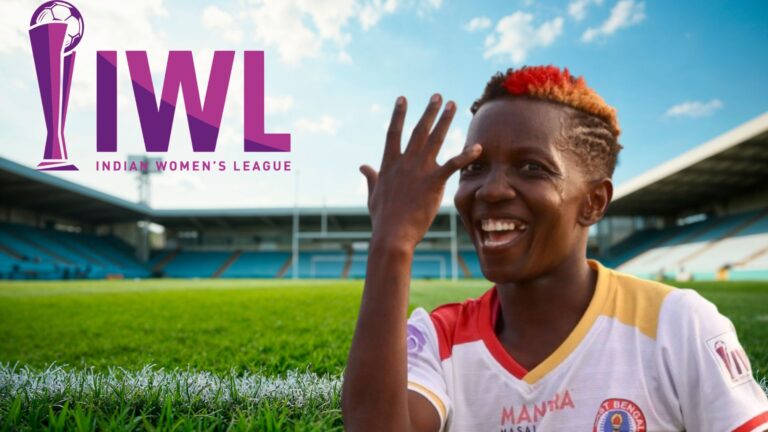
East Bengal Women entered the IWL only four seasons ago. In only their third season, 2024-25, they won the title. Then they won it again in 2025-26. Back-to-back IWL champions. The only other club to win multiple IWL titles is Gokulam Kerala, who won three straight and remain the benchmark for what sustained excellence in this league looks like.
What East Bengal did differently from most clubs in the league was invest seriously and strategically. They paid what was reported as a record transfer fee to bring in coach Anthony Andrews — who had previously guided Gokulam to two IWL titles — and then backed him in the transfer market. They recruited India internationals. And they signed Fazila Ikwaput.
Fazila Ikwaput and the Foreign Player Question
If you want to understand what the IWL is becoming, watch Fazila Ikwaput play.
The Ugandan striker is, by some distance, the most complete footballer in the league. She first arrived in India with Gokulam Kerala, where she won the Golden Boot in back-to-back seasons and became the defining attacking player of the league’s middle era. When East Bengal came calling ahead of 2024-25, she moved to Kolkata. Her previous club lost their best player. East Bengal gained one.
Ikwaput scored 24 goals in the 2024-25 IWL season. She scored 20 in 2025-26. Across all competitions for East Bengal in 2025-26, including the AFC Women’s Champions League and the SAFF Women’s Club Championship, she scored 31 goals. At the season’s end, the IWL record books confirmed she had passed the all-time goal record for the competition.
She is the best argument the IWL has for its own quality. She is also the most pointed illustration of its central recruitment challenge: the league’s top players, foreign or domestic, can earn considerably more elsewhere. The fact that Ikwaput has stayed in India across multiple seasons — first at Gokulam, then at East Bengal — says something about the league’s improving competitive environment. Whether she stays beyond her current deal, or whether a better-paying league comes in, is the IWL’s most pressing individual story heading into 2026-27.
She is not the only foreign player. The IWL has drawn players from Ghana, Uganda, Cameroon, Nigeria, Nepal, and beyond — a West African pipeline in particular that has consistently raised the league’s attacking quality. Clubs like Sribhumi, Sethu, Kickstart, and Nita have all used foreign signings strategically. The effect on the league’s standard is real. The effect on player welfare — whether those foreign signings are being paid fairly for leaving their home countries to play in India — is a question the AIFF has not answered publicly.
The Pay Problem
The IWL cannot be discussed honestly without addressing what players earn. Or more precisely, what most of them don’t earn.
The men’s Indian Super League pays its players an average of ₹50-60 lakh per year. Its top earners command crores. The IWL, at the level most clubs operate, pays domestic players somewhere between ₹50,000 and ₹1 lakh for the entire season. The national team captain, Ashalata Devi, described it several years ago in terms that haven’t lost their force: “Indian football clubs treat female players like vegetables. Many players don’t even get ₹1 lakh in a season. The girls do equal hard work as the male players but where is the reward?”
The situation has improved modestly at the top end. East Bengal and Gokulam, the two clubs with the most institutional backing and investment appetite, pay their players more than the league average — they have to, to attract and retain the national team players their squads are built around. But the IWL as a whole has no minimum wage requirement for players. No disclosed salary floor. No CBA. Each club sets its own terms, and most clubs operate on shoestring budgets that leave players needing second incomes to sustain a professional football career.
This is the IWL’s pay-to-play problem, and it runs directly parallel to the WFA story in American women’s football: a league that is structurally serious, growing in quality, and nationally broadcast — but where the economics haven’t yet reached the athletes who make it run.
The Continental Test
When East Bengal qualified for the 2025-26 AFC Women’s Champions League as IWL champions, it was only the second time an Indian club had reached Asia’s premier women’s club competition. Odisha FC had done it the season before, progressing from the preliminary stage to the group stage before exiting. East Bengal were expected to build on that.
The preliminary stage went well. East Bengal topped their group ahead of Hong Kong’s Kitchee SC and Cambodia’s Phnom Penh Crown FC, which was the benchmark set for them. The group stage in China was a different level entirely.
Drawn into Group B alongside Wuhan Jiangda as hosts, East Bengal entered facing opponents from a football ecosystem that operates at a categorically higher level of funding, infrastructure, and full-time professionalism. The gap showed. East Bengal lost to Uzbekistan’s PFC Nasaf 3-0 in their opening match — a defeat that was honest about the distance between where the IWL is and where the AFC Women’s Champions League’s competitive midfield sits.
That gap is not a failure. It is data. It shows exactly what the IWL needs to close if Indian club football is going to become genuinely competitive at the continental level. The clubs playing at the top of the AFC Women’s Champions League are professional outfits in a full sense — full-time training, significant salaries, proper medical infrastructure. East Bengal are a serious club by IWL standards. By continental standards, they are still catching up.
The experience matters regardless. Playing against Nasaf and Wuhan Jiangda exposed East Bengal’s players — and the national team players within that squad — to a standard of football they couldn’t encounter domestically. That is exactly what continental competition is supposed to do for a developing league’s clubs.
279 People
The most uncomfortable number in Indian women’s football right now is not a salary figure. It is an attendance figure.
In the 2024-25 IWL season, the average attendance across all matches was 279. The best-attended game drew 1,920 — the East Bengal versus Gokulam Kerala title decider in Kolkata, where the sporting stakes were at their highest and the local club was on the verge of history.
279 people per game. In a country of 1.4 billion, where cricket commands billion-viewer audiences and even the men’s I-League draws respectable crowds, women’s football is playing to near-empty stands.
The 2025-26 season, played across two phases with the first phase in Kolkata and Kalyani, showed encouraging progress around East Bengal’s home matches — the atmosphere described by multiple reporters as something genuinely building in the city around the women’s side. But the structural challenge remains: the IWL does not yet have a home-and-away culture with clubs playing in their own cities in front of their own communities. The centralised venue format, used for logistical reasons, strips the league of the local identity that builds fanbases organically.
AIFF announced that from 2023-24 the league would move to a home-and-away format. The 2025-26 season was the ninth edition of the IWL. The vision is right. The execution, in terms of bringing real crowds to real home venues across multiple cities, is still a work in progress.
The Pyramid That Could Change Everything
The IWL 2’s arrival in 2023 was the structural breakthrough that often gets overlooked in coverage of Indian women’s football.
Before IWL 2 existed, the pathway from state football to the national league was unclear, informal, and dependent on AIFF nominations rather than merit-based promotion. A talented teenager in Tamil Nadu playing for a state club had no clear route to the IWL. The talent identification was happening — Manipur, Kerala, and West Bengal in particular have produced a steady stream of national team players through their state leagues — but the competitive structure connecting state football to the top flight didn’t exist in any formal sense.
IWL 2 changed that. Now, the top two teams from IWL 2 earn promotion to the IWL. The bottom teams from the IWL face relegation. The state leagues feed IWL 2. It is a proper pyramid — the kind of competitive structure that creates incentive and ambition at every level, from a village team in Manipur to a club competing for an AFC Women’s Champions League spot.
The effects are already visible. Clubs like Nita Football Academy from Cuttack, promoted through IWL 2, are competing at the top level. Garhwal United FC avoided relegation in 2025-26 on the final day. The jeopardy is real. That jeopardy — the genuine threat of dropping down, the genuine reward of moving up — is what makes a professional league feel professional.
The Stories to Watch
Fazila Ikwaput’s future. She is the IWL’s best player and the league’s biggest individual asset. Her contract situation heading into 2026-27 is the transfer story that matters most. If she stays, East Bengal’s dominance continues. If she moves — to a European or Asian league that can pay significantly more — it signals that the IWL still can’t retain its best talent.
Whether AIFF formalises a minimum wage. The absence of any disclosed salary floor for IWL players is the league’s most glaring structural gap. A minimum wage — even a modest one — would change the conversation about what it means to be a professional women’s footballer in India. The BCCI’s WPL has demonstrated what a franchise model can do for women’s cricket pay. The IWL needs its own version of that conversation.
East Bengal’s AFC Women’s Champions League campaign. As the 2025-26 IWL champions, East Bengal will represent India again in 2026-27. How far they go — and whether the squad investment continues to grow — will determine whether Indian club football can genuinely close the continental gap or whether the AFC appearance remains a learning exercise.
The IWL 2 promotion race. The stories at the bottom of the pyramid are often the most interesting. Which state league clubs are pushing through, who gets promoted, and where the next generation of IWL players is coming from — that’s where Indian women’s football’s future is being decided, and it’s almost entirely uncovered.
The Honest Assessment
The IWL in 2026 is a league in the right direction. The promotion pyramid is real. The continental pathway is real. The quality, driven by a combination of emerging domestic talent and smart foreign recruitment, is visibly improving season on season. East Bengal’s back-to-back titles have given the league a dominant club story that it previously lacked. Fazila Ikwaput is a genuine star.
But the gaps are also real. Players are still earning less than ₹1 lakh in many cases. Crowds average in the hundreds, not the thousands. The AFC Women’s Champions League, when Indian clubs get there, reveals the distance still to travel against fully professional opposition.
None of that is disqualifying. It is where most developing leagues are at a comparable stage of growth. The NWSL looked similar a decade ago — structurally sound, improving, but financially and commercially not yet where it needed to be. The league’s job now is to convert structural progress into commercial momentum. That means better pay, proper home venues, and at least one moment — a Caitlin Clark equivalent, a title run that captures the national imagination — that puts Indian women’s football in front of an audience that isn’t already looking for it.
The bones are good. Now it needs the flesh.