



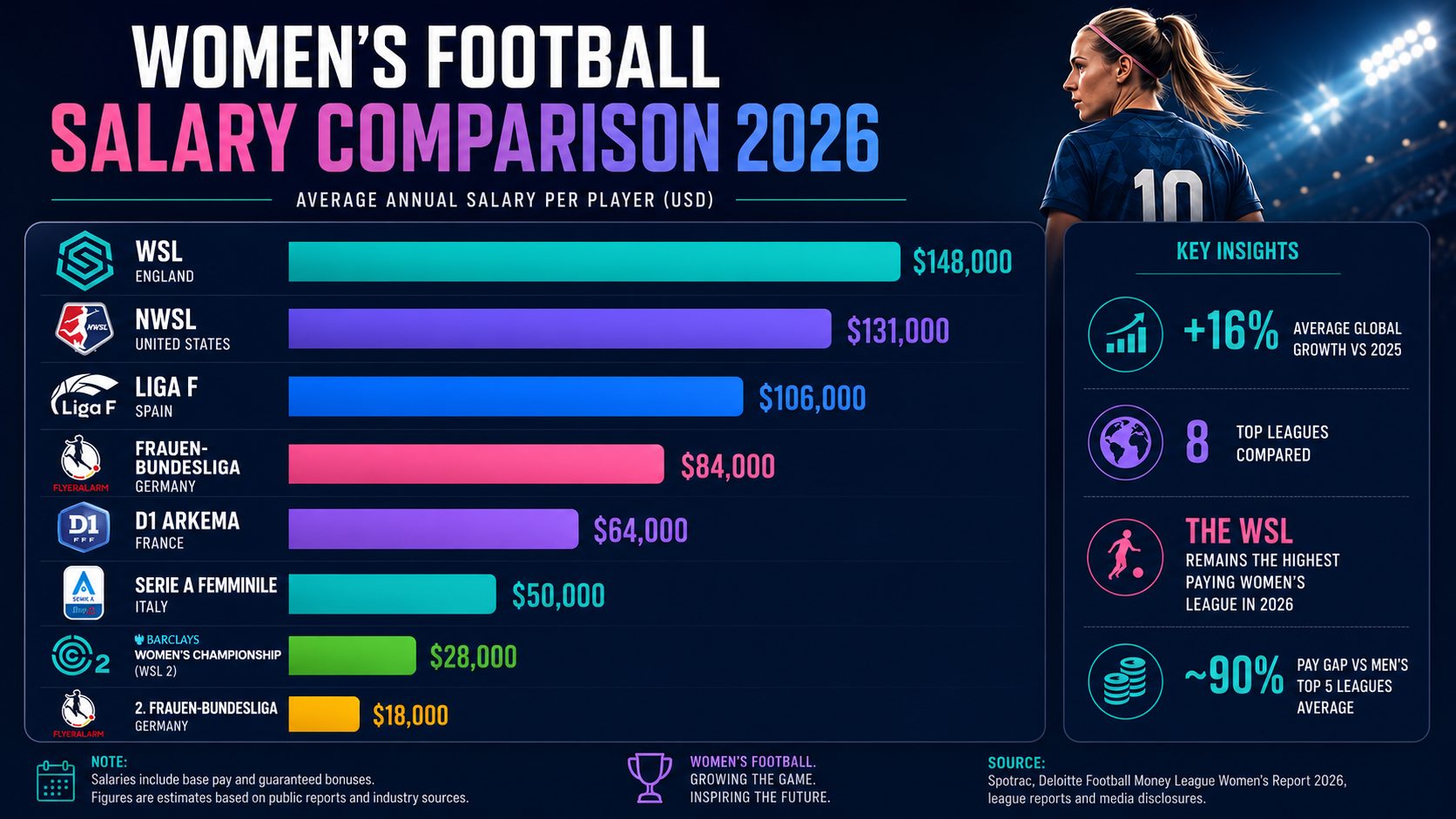
A complete breakdown of wages across the NWSL, WSL, Liga F, and the global leagues paying the most — and what the numbers reveal about where the sport is headed.
Published: June 6, 2026 | Reading time: 12 minutes | Category: Money & Power
Introduction: The Money Is Moving
In March 2026, Barcelona Femení won their third consecutive UEFA Women’s Champions League title. Their victory was historic. But what happened off the pitch that same week was arguably more significant: the club announced a new commercial partnership worth €8 million annually — the largest single sponsorship deal in women’s club football history.
The money is finally moving. But where is it going? And how much of it is reaching the players?
This article breaks down what women’s footballers actually earn in 2026 across the world’s top leagues, how those numbers compare to men’s football, and what the salary data tells us about which leagues are winning the battle for global talent.
The Global Salary Landscape: Four Tiers
Women’s football operates in a four-tier economic system. Understanding these tiers is essential to understanding where the sport is headed.
TIER 1: The Elite — €300,000 to €700,000+ per year
Leagues: NWSL (USA), WSL (England), Liga F (Spain), Division 1 Féminine (France)
These are the only leagues where a significant number of players earn six-figure salaries. But even here, the range is vast.
NWSL (USA)
Table
| Metric | Figure |
|---|---|
| Salary cap per team | $2.85 million (2026 season) |
| Maximum individual salary | $350,000 (unallocated players) |
| Minimum salary | $48,500 |
| Average estimated salary | $85,000–$120,000 |
The NWSL’s 2024 collective bargaining agreement fundamentally reshaped the market. The salary cap has risen 40% since 2023, and allocation money allows teams to pay star players above the cap. The result: the NWSL is now the highest-paying league for the average player, even if European clubs can offer higher wages to individual stars.
WSL (England)
Table
| Metric | Figure |
|---|---|
| Salary structure | No hard cap; financial sustainability rules apply |
| Top earners (Chelsea, Arsenal, Man City) | €400,000–€600,000 |
| League average | €55,000–€75,000 |
| Minimum | Not mandated; estimated €25,000–€30,000 |
The WSL’s lack of a salary cap creates wild inequality. Chelsea’s squad wage bill is estimated to be 4x that of bottom-half clubs. This is attracting top talent — but raising questions about competitive balance.
Liga F (Spain)
Table
| Metric | Figure |
|---|---|
| Top earners (Barcelona, Real Madrid) | €500,000–€700,000 |
| League average | €45,000–€60,000 |
| Minimum | €24,000 (mandated) |
Barcelona and Real Madrid dominate. Their combined wage bills exceed the rest of the league combined. This two-club economy is both Liga F’s strength and its vulnerability.
Division 1 Féminine (France)
Table
| Metric | Figure |
|---|---|
| Top earners (Lyon, PSG) | €400,000–€600,000 |
| League average | €40,000–€55,000 |
| Minimum | €20,000 (estimated) |
Lyon’s decade-long dominance was built on early investment. Now they’re being challenged by PSG and, increasingly, by American and English clubs with deeper commercial revenue.
TIER 2: The Professional Class — €50,000 to €200,000
Leagues: Damallsvenskan (Sweden), Frauen-Bundesliga (Germany), Serie A Femminile (Italy), A-League Women (Australia)
These leagues are fully professional but operate on tighter budgets. They increasingly serve as developmental leagues or destinations for players seeking playing time over maximum wages.
Frauen-Bundesliga (Germany)
Table
| Metric | Figure |
|---|---|
| Top earners | €150,000–€200,000 |
| League average | €35,000–€50,000 |
| Minimum | €18,000 (estimated) |
Germany’s structural strength — strong youth development, high attendance — hasn’t yet translated into top-tier wages. Bayern Munich and Wolfsburg are exceptions; most clubs operate modestly.
Damallsvenskan (Sweden)
Table
| Metric | Figure |
|---|---|
| Top earners | €100,000–€150,000 |
| League average | €25,000–€35,000 |
| Minimum | €15,000 (estimated) |
Sweden’s league was once the world’s best-paid. It has been overtaken, but remains a destination for players prioritizing work-life balance and competitive football.
TIER 3: The Semi-Professional Majority — €10,000 to €50,000
Leagues: Top divisions in Portugal, Netherlands, Norway, Denmark, Belgium, Brazil, Mexico, Japan, South Korea
This is where most professional women’s footballers live. They are paid, but not enough to retire on. Many work second jobs, study, or rely on family support.
Campeonato Brasileiro Feminino (Brazil)
Table
| Metric | Figure |
|---|---|
| Top earners | €40,000–€60,000 |
| League average | €8,000–€15,000 |
| Minimum | €4,000–€6,000 (estimated) |
Brazil’s domestic league is growing rapidly, fueled by the success of the national team and the return of star players from Europe. But commercial revenue remains minimal.
WE League (Japan)
Table
| Metric | Figure |
|---|---|
| Top earners | €50,000–€80,000 |
| League average | €15,000–€25,000 |
| Minimum | €10,000 (estimated) |
Japan’s fully professional WE League, launched in 2021, is a model of sustainable growth. Salaries are modest but reliable, and corporate sponsorship is deeply embedded.
TIER 4: The Rest — Under €10,000 or Unpaid
Leagues: Lower divisions in Europe, most of Africa, most of Asia, most of Latin America
The majority of women’s footballers worldwide fall into this category. They play for love of the game, national team aspirations, or the hope of eventually reaching a paying league.
The Gap: Women’s vs. Men’s Salaries
The numbers are stark.
Table
| Comparison | Women’s | Men’s | Ratio | |
|---|---|---|---|---|
| NWSL max salary | $350,000 | MLS max salary (DP) | $3.5M+ | ~1:10 |
| WSL top earner | €600,000 | Premier League average | €4M+ | ~1:7 |
| Liga F top earner | €700,000 | La Liga average | €2.5M+ | ~1:4 |
| World Cup prize pool (2023) | $110M | World Cup prize pool (2022) | $440M | 1:4 |
But the trajectory matters more than the current gap. The women’s World Cup prize pool has grown 300% since 2015. NWSL salaries have doubled since 2021. The WSL’s broadcast deal, renewed in 2024, was a 6x increase on the previous agreement.
The gap is still massive. But the rate of change in women’s football is faster than in men’s football at any equivalent stage of development.
Where the Money Comes From (And Where It’s Going)
Understanding player salaries requires understanding revenue. Women’s football clubs earn money from four sources:
- Broadcast rights — Growing but still small. The WSL’s £65M/year deal is the largest women’s football broadcast contract globally.
- Commercial sponsorship — The fastest-growing category. Brands are paying premium rates to associate with women’s football because the audience is younger, more engaged, and less saturated with advertising.
- Matchday revenue — Highly variable. Barcelona Femení regularly draws 40,000+. Many WSL clubs average under 5,000.
- Player trading — Transfer fees in women’s football were negligible five years ago. In 2025–26, they exceeded €10M globally for the first time.
The shift: Revenue is moving from federation subsidies and men’s club cross-subsidies toward standalone commercial sustainability. This is the critical transition that will determine future salary growth.
Case Study: The American Invasion
In 2024–25, something unprecedented happened: American players began moving to Europe in large numbers while still in their prime.
Historically, US players went to Europe late in their careers or not at all. The NWSL paid enough to keep them home. But as European wages rose and the NWSL salary cap created a ceiling for non-star players, the calculus changed.
Notable moves (2024–2026):
Table
| Player | From | To | Year |
|---|---|---|---|
| Trinity Rodman | Washington Spirit | Chelsea | 2025 |
| Jaedyn Shaw | San Diego Wave | Manchester City | 2025 |
| Korbin Albert | PSG | Lyon | 2024 |
This talent flow is Europe’s gain and America’s challenge. It signals that the NWSL’s early-mover advantage is eroding — and that the global market for women’s football talent is becoming genuinely competitive.
What This Means for the Next Five Years
Based on current trends, here are five predictions:
- The NWSL will lose its status as the default highest-paying league. European clubs with deeper men’s team resources and larger global fanbases will outspend American teams on individual stars.
- A women’s “super league” will emerge. The UEFA Women’s Champions League is effectively becoming this, but a formalized super league with guaranteed spots for the wealthiest clubs is likely by 2030.
- Salary caps will spread. The WSL will likely implement one within three years to control the Chelsea/Arsenal/Manchester City arms race.
- The middle class will grow. Tier 2 and Tier 3 leagues will see the fastest percentage salary growth as broadcast and sponsorship money filters down.
- Player trading will become a real market. Transfer fees will reach €50M+ for individual players by 2030, creating new economic incentives for clubs to invest in youth development.
The Bottom Line
Women’s football salaries in 2026 are simultaneously impressive and inadequate. A top player can earn €700,000 — a figure unimaginable a decade ago. But most professional players earn less than a mid-level office worker, and the majority of women’s footballers worldwide are unpaid.
The business story is this: the revenue is coming, the audience is growing, and the investment is accelerating. The question is not whether women’s football will become financially sustainable. The question is whether the current generation of players will see the benefits, or whether those rewards will flow primarily to the next generation.
For now, the data tells a clear story: if you’re a talented young footballer in 2026, your earning potential has never been higher. But where you play — and which league’s economic model you bet on — matters more than ever.
Sources: NWSL Players Association, FIFPRO Global Employment Report, UEFA Women’s Football Benchmarking Report, club financial disclosures, published player contracts, estimated figures based on industry reporting.