

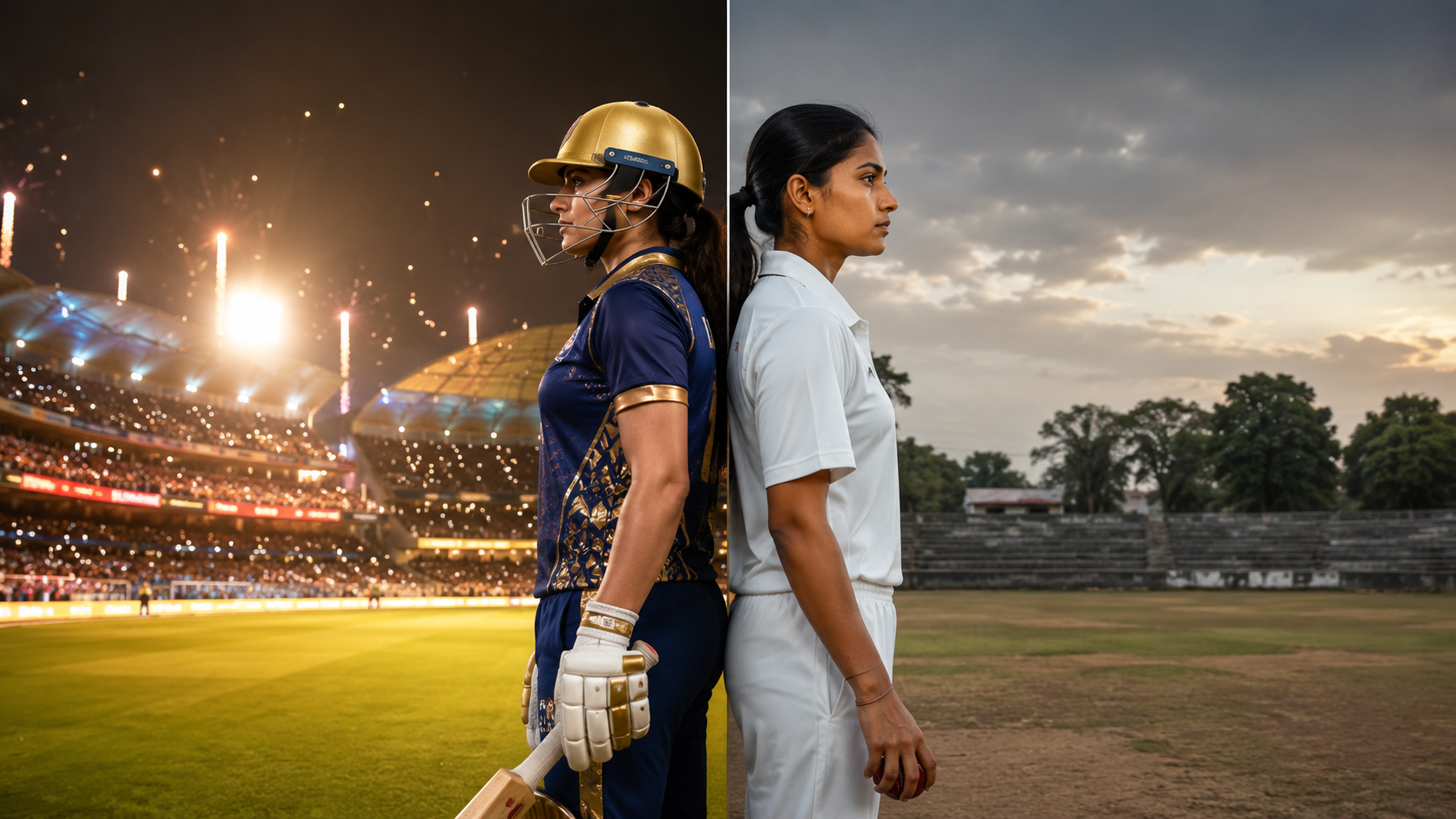
Inside the money, the audience, and the global power shift reshaping women’s cricket — from the IPL shadow to its own spotlight.
Published: June 6, 2026 | Reading time: 11 minutes | Category: Money & Power
Introduction: The Night Everything Changed
March 2023. The first ever Women’s Premier League auction. Smriti Mandhana went to Royal Challengers Bangalore for ₹3.4 crore — approximately $410,000. It was the highest price ever paid for a women’s cricketer. The cricket world stopped and stared.
Three years later, the WPL is no longer an experiment. It’s a commercial force. The 2026 season saw franchise valuations cross $100 million. Broadcast rights are being renegotiated at 4x the original price. And the Board of Control for Cricket in India (BCCI) is openly talking about expanding the league to 10 teams and a 34-match season.
What happened? And what does it mean for women’s cricket everywhere else?
This article breaks down the economics of the WPL, how it compares to women’s cricket in Australia and England, and why India’s league is becoming the gravitational center of the global women’s cricket economy.
The WPL by the Numbers: 2026
Table
| Metric | Figure |
|---|---|
| Teams | 5 (Mumbai Indians, Delhi Capitals, RCB, UP Warriorz, Gujarat Giants) |
| Season duration | 22 matches, 3 weeks |
| Total player purse pool | ₹60 crore (~$7.2M) |
| Highest-paid player (2026) | ₹4.2 crore (~$505,000) |
| Franchise valuation range | $80M–$120M |
| Broadcast deal (2023–2027) | ₹951 crore (~$116M) for 5 years |
| Average match attendance | 18,000–25,000 |
| Digital viewership (2025 final) | 50 million+ concurrent streams |
These numbers are modest compared to the men’s IPL. But the trajectory is what matters. The WPL’s first broadcast deal was 10x larger than any previous women’s cricket broadcast contract globally. And franchise valuations have tripled since launch.
Where the Money Comes From
Franchise Ownership
Every WPL franchise is owned by the same corporate groups that own men’s IPL teams:
Table
| Franchise | Owner | Men’s IPL Equivalent |
|---|---|---|
| Mumbai Indians | Reliance Industries (India’s largest company) | Mumbai Indians |
| Delhi Capitals | JSW Group & GMR Group | Delhi Capitals |
| Royal Challengers Bangalore | United Spirits (Diageo) | RCB |
| UP Warriorz | Capri Global | — |
| Gujarat Giants | Adani Group | Gujarat Titans |
This is the critical structural advantage. These owners have existing infrastructure — stadium access, sponsorship networks, digital teams, merchandise supply chains. The WPL piggybacks on the IPL machine. That keeps costs down and revenue potential high.
Broadcast and Digital
The WPL’s broadcast deal with Viacom18 (JioCinema) was revolutionary for one reason: it was free to stream. Every match was available at no cost on JioCinema, India’s largest digital platform.
Result: 50 million concurrent viewers for the 2025 final. Compare that to the 2023 Women’s T20 World Cup final, which drew 10 million.
The model is clear: sacrifice subscription revenue for audience scale, then monetize through advertising and future paid tiers. It’s the same playbook that built the IPL into a $10 billion property.
Sponsorship
WPL franchises are signing independent sponsors at rates that would have been unimaginable for women’s cricket five years ago:
- Mumbai Indians: 8+ dedicated WPL sponsors, including Hero MotoCorp and Dream11
- RCB: Separate WPL jersey sponsor (Hindustan Unilever) from men’s team
- Delhi Capitals: WPL-specific partnerships with ITC and Jindal Steel
The key shift: sponsors are treating WPL franchises as standalone assets, not appendages to men’s teams. That signals genuine commercial confidence.
Player Economics: What WPL Cricketers Actually Earn
The Salary Structure
Table
| Tier | Salary Range (₹ crore) | Salary Range (USD) | Player Count |
|---|---|---|---|
| Mega stars | ₹3.0–₹4.2 | $360K–$505K | 5–8 players |
| Core internationals | ₹1.5–₹3.0 | $180K–$360K | 15–20 players |
| Emerging Indian players | ₹50L–₹1.5 crore | $60K–$180K | 30–40 players |
| Domestic/uncapped | ₹10L–₹50L | $12K–$60K | 40–50 players |
The top earners — Smriti Mandhana, Harmanpreet Kaur, Meg Lanning, Nat Sciver-Brunt — now earn more from three weeks of WPL cricket than they previously made in an entire year of international cricket and domestic contracts combined.
The Australian Comparison
Australia’s Women’s Big Bash League (WBBL) was the world’s premier women’s T20 league before the WPL. How do they compare?
Table
| Metric | WPL (India) | WBBL (Australia) |
|---|---|---|
| Top salary | $505,000 | $150,000 (AUD) |
| Season duration | 3 weeks | 2 months |
| Total matches | 22 | 59 |
| Average player salary | ~$85,000 | ~$35,000 |
| Broadcast deal | $116M (5 years) | $40M (5 years, combined with men’s BBL) |
| Franchise model | Yes | No (state teams) |
The WPL has overtaken the WBBL on every financial metric. Australian players now view WPL contracts as their primary earning opportunity — a complete inversion of the global cricket economy.
The English Comparison
England’s The Hundred includes a women’s competition, but it’s not a standalone franchise league. The ECB’s central contracts for England women pay £50,000–£150,000 annually. The WPL offers 2–3x that for three weeks’ work.
The result: England’s best players — Nat Sciver-Brunt, Danni Wyatt-Hodge, Sophie Ecclestone — prioritize WPL availability over English domestic cricket. This is creating tension with the ECB and raising questions about the future structure of English women’s cricket.
The Global Power Shift: What WPL Dominance Means
The Talent Drain
The WPL’s financial gravity is pulling the world’s best players toward India. This is creating a two-class system:
Table
| Category | Who It Includes | Situation |
|---|---|---|
| WPL-eligible internationals | Australians, English, New Zealanders, West Indians, some South Africans | Earn 70%+ of annual income from WPL |
| WPL-excluded players | Pakistanis (political), Bangladeshis, Sri Lankans, most Africans | Dependent on national contracts and domestic leagues with minimal pay |
Pakistani cricketers are notably absent — no Pakistani has played in the WPL due to India-Pakistan political tensions. This is creating a parallel universe where Pakistani women’s cricket develops in isolation, without access to the sport’s largest revenue pool.
The League Proliferation Response
Other cricket boards are scrambling to create their own franchise leagues:
Table
| League | Status | Launch |
|---|---|---|
| Women’s Caribbean Premier League (WCPL) | Active, 3 teams | 2022 |
| Women’s Big Bash League (WBBL) | Active, 8 teams | 2015 |
| The Hundred (England) | Active, 8 teams | 2021 |
| Women’s SA20 (South Africa) | Active, 6 teams | 2023 |
| Women’s Bangladesh Premier League | Proposed | 2026–27 |
| Women’s Pakistan Super League | Proposed | TBD |
None of these can match the WPL’s financial scale. The SA20, backed by the same IPL owners, comes closest. But the WPL’s first-mover advantage and India’s market size create a moat that will be difficult to cross.
The Uncomfortable Questions
The WPL’s success raises issues that the cricket establishment is reluctant to address:
1. The IPL Subsidy Question
Are WPL franchises profitable on their own? Or are they loss-leading marketing exercises subsidized by the men’s IPL?
No franchise has disclosed standalone WPL financials. Industry estimates suggest most operate at a loss or break-even, treating the WPL as brand-building and future-option value. The real profitability may come from merchandise, digital engagement, and eventual broadcast rights appreciation — not current match revenue.
2. The Indian Player Quota
WPL rules require 7 Indian players per XI. This protects domestic talent but limits global integration. Compare to the WBBL, where Australian players compete directly with the world’s best every match.
The quota system accelerates Indian player development but may slow the league’s competitive evolution. It’s a trade-off between national development and global league quality.
3. The Schedule Squeeze
The WPL’s 3-week window is brutally compressed. Players arrive, play 4–6 matches, and leave. There’s no time for community building, fan engagement, or commercial activation.
The BCCI has signaled expansion to 8 teams and 34 matches by 2028. That would extend the season to 6–7 weeks and create more sustainable player workloads. But it also increases the risk of player burnout and international schedule conflicts.
What Happens Next: Five Predictions
- WPL franchise valuations will hit $200M by 2028. The next broadcast rights cycle (2028–2032) will be the catalyst. Expect $300M+ for 5 years.
- An independent players’ association will form. Current WPL contracts are standard BCCI templates. As player earnings grow, demand for independent representation will follow.
- Australia will create a franchise model. The WBBL’s state-team structure cannot compete with the WPL. Cricket Australia will face pressure to privatize or lose talent.
- A women’s IPL-style league will launch in the UAE or Saudi Arabia. Gulf investment in cricket is growing. A women’s league with WPL-style money but fewer schedule constraints is a logical next step.
- The ICC will create a women’s cricket calendar window. The current free-for-all, where leagues operate whenever they can find space, is unsustainable. A formal “league season” will emerge, similar to football’s summer transfer window.
The Bottom Line
The WPL is not just a cricket league. It’s a proof of concept that women’s sports franchises can be valued in the hundreds of millions, that broadcasters will pay premium rates for women’s content, and that the Indian market can drive global sports economics.
For women’s cricket specifically, the WPL has created a gold rush mentality. Players are earning life-changing money. Leagues are launching everywhere. And the sport’s visibility has multiplied.
But the concentration of wealth in one league, in one country, for three weeks a year, is also a vulnerability. Women’s cricket needs the WPL to succeed. It also needs the WBBL, The Hundred, and whatever comes next to thrive independently. A single gravitational center is exciting. A diverse ecosystem is sustainable.
The bet being made — by the BCCI, by franchise owners, by broadcasters, by sponsors — is that women’s cricket is not a smaller version of men’s cricket. It’s a different product with different economics and a different future. The WPL is the first major test of that hypothesis. Three years in, the early returns are strong.
Sources: BCCI annual reports, WPL franchise disclosures, Cricket Australia financial statements, ECB annual review, FICA (Federation of International Cricketers’ Associations) surveys, broadcast rights data from Viacom18, industry reporting from ESPNcricinfo and Wisden.